STRIDERS NEWS

Published on
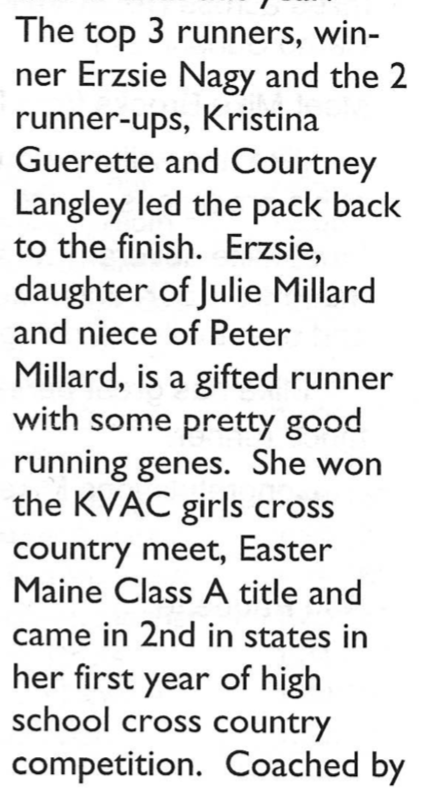
This month we're running back to 2013, which seems to have been a resurgent year for the Striders.  In fact, you could probably say that it was the start to a new era for the club.  There were a lot of great articles reminiscing about the past from some club members that had been around a long time, and at the same time, it seems that Patrick Guerette, along with the help of Harold Shaw and a few others, were bringing the club into the modern era.  The webpage was created, a Facebook page started, and the Quarry Road Summer Race series was run for the first time.
Picture
There were so many good articles in the Interval in 2013 that I just can't include them all in this job into the archives.  I don't want to make it an "ultra jog" into the past, since O don't want too many DNF's on this edition.
Picture
We don't have space to print the whole article here, but I'm going to bet that Craig Lewis is/was some kind of medical professional, possibly a sports doctor or physical therapist.  His article in the January 2013 Interval started out with:

"I have been collecting health benefits of exercise articles for five decades."

FIVE DECADES!  That's a lot of articles!

He also used lots of big medical words and phrases, like rapamycin, enzymic, telomere, senescent, and hippocampi.

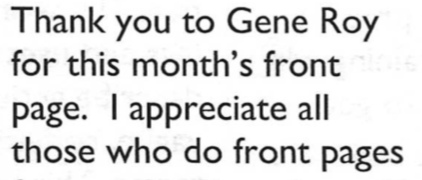
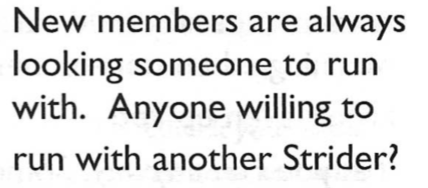
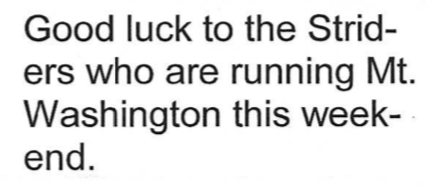
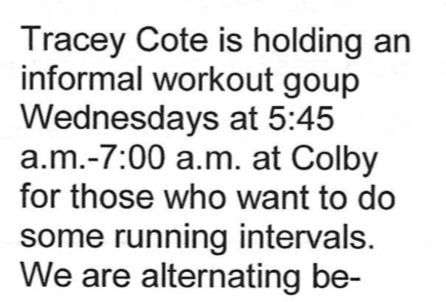
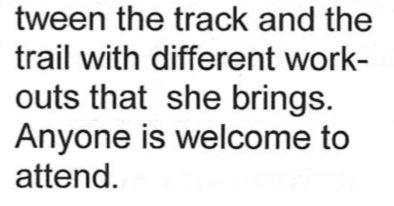
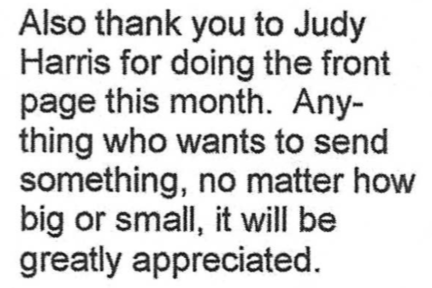
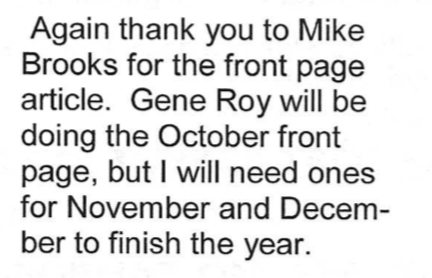
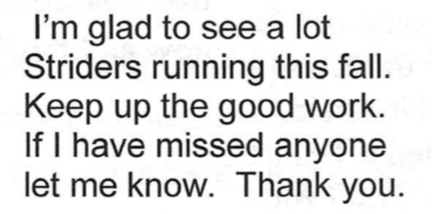
As was the norm during a long period of Interval newsletters, Linda Benn saved a small spot on the bottom of the front page for some news or notes from the editor:
Picture
Picture
Picture
Picture
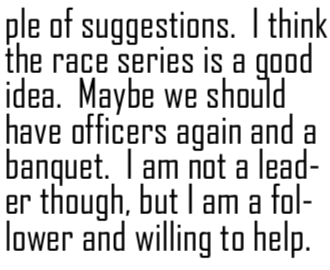
.  Did somebody say race series?

Oh, and someone mentioned officers?

Yes, that's right.  When 2013 started, the Striders didn't have any officers and there weren't any local race series.

And that's when Patrick Guerette showed up and more or less transformed the Striders into what they are today.  

​(Yes, Patrick, that's right.  I'm giving you credit, because you deserve it.  Thanks for everything you've done for the club.)

Announcement for the 2013 January Thaw :
Picture
Picture
Picture
Picture

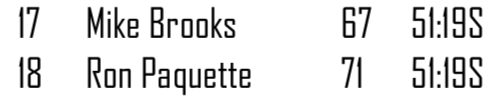
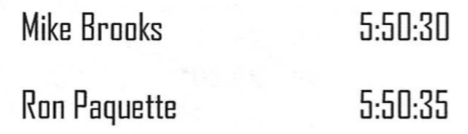
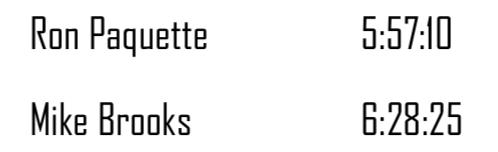
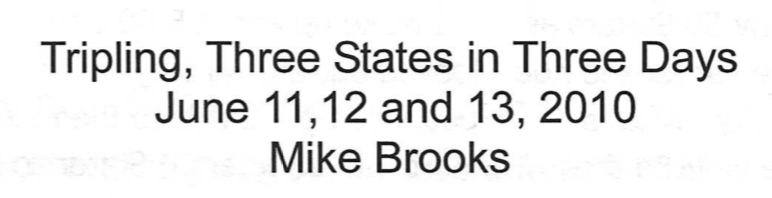
Strider Mike Brooks had his named splashed on the pages of the Interval several times in 2013.  Usually, he was just running little races like the the Ironhorse 100 Miler in Florida, the Bataan Death March in New Mexico, running three marathons in three days around Lake Tahoe, the "Dust Bowl Races" (5 marathons in 5 days in 5 different states -- Texas, Oklahoma, Kansas, Colorado, and New Mexico), or the "Savage Seven" (7 marathons in 7 days in Florida).  

[In a probably not related story, I saw on Facebook recently that Mike recently had total knee replacement surgery.  Mike, we hope your knee heals quickly and you're able to get back to running many marathons in many consecutive days soon!]
Picture
Picture
Ron Paquette and Mike Brooks at the Ironhorse 100 races in Florida
Picture
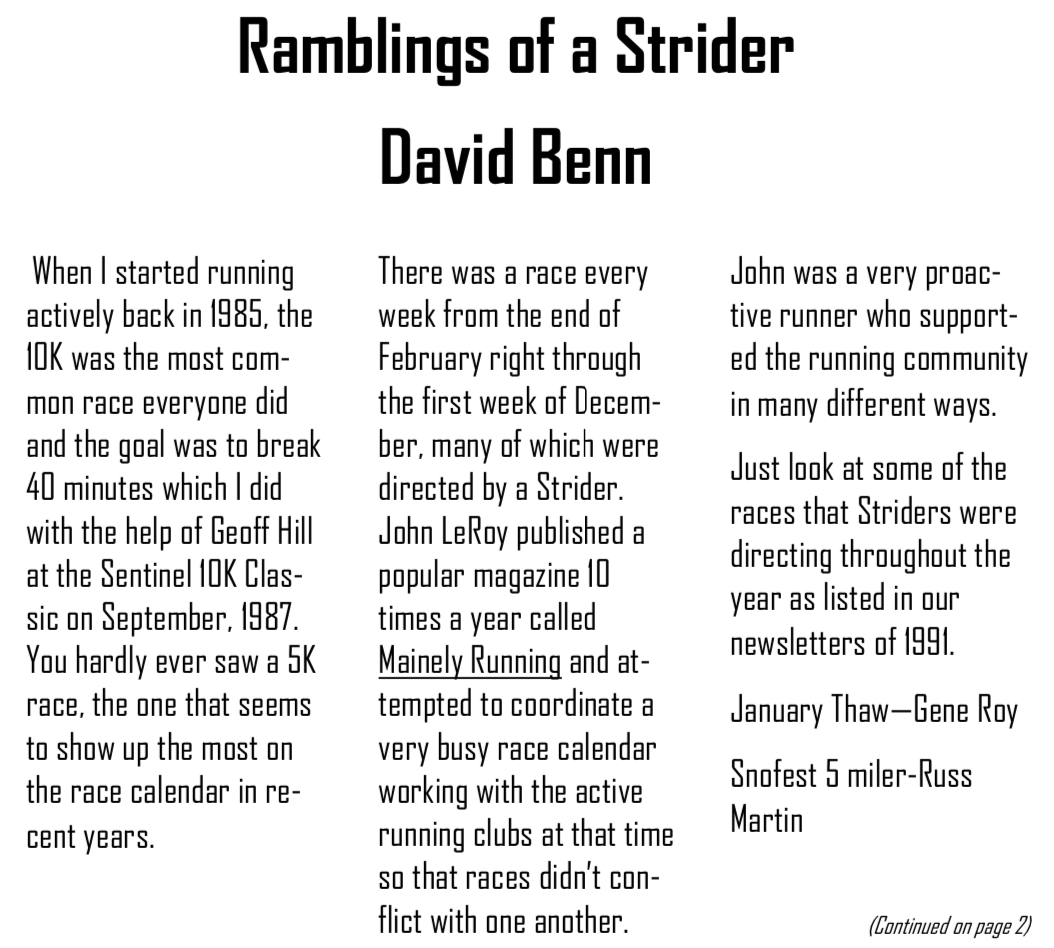
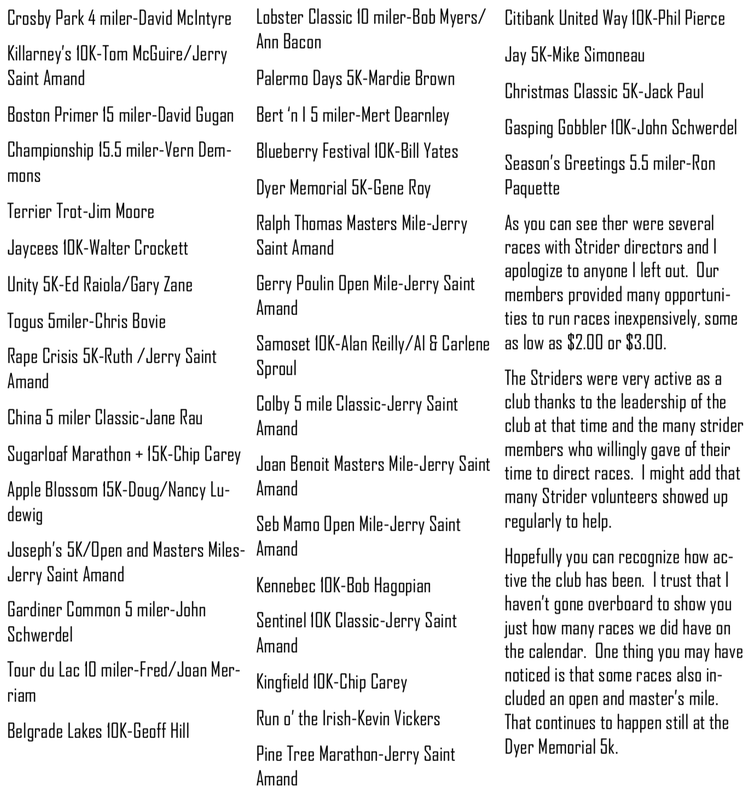
One of the many historically interesting articles in that year, was this one from David Benn in the February 2013 issue of the Interval.  It gives you an idea of just how active the Striders were as a club in their heyday and how many races they put on, AND how many different club members were race directors.
Picture
Picture
Picture
Picture
Picture
Picture
Picture
Picture
For the full results from the 2013 January Thaw Road Race, click here.
Picture

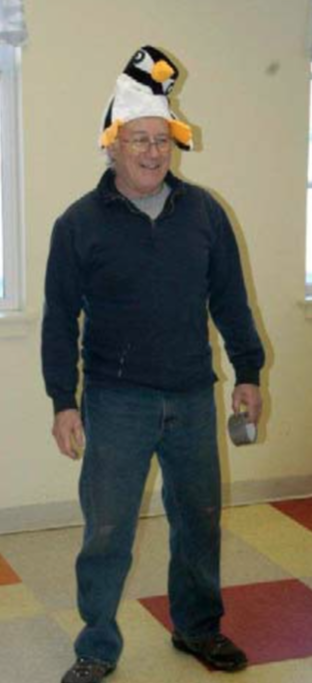
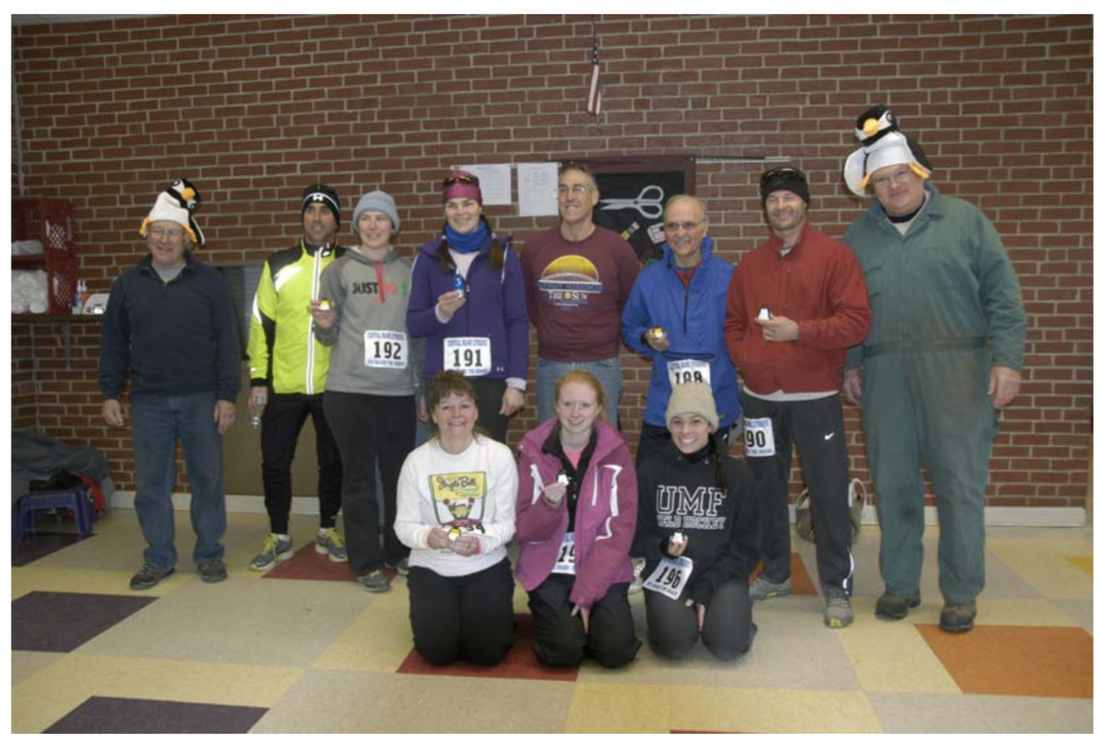
Perhaps the "penguins" were too intimidating, which is why most of the 2013 January Thaw race finishers aren't in this photo.

In early March of 2013, there was a Striders meeting and some of the items discussed included:
- "A new CMS slogan.  "we share the roads" doesn't accurately reflect the makeup of runners in Central maine, because we share everything. [As far as I know, the slogan was just dropped and not replaced]
- Bringing back some CMS singlets and t-shirts for members.
- Developing a Central Maine Striders website.  Key components being a race & events calendar as well as a way to join the Striders (printable or online reg). -- Harold Shaw
- Add any upcoming races to the Facebook Page under events, great way to promote your race 
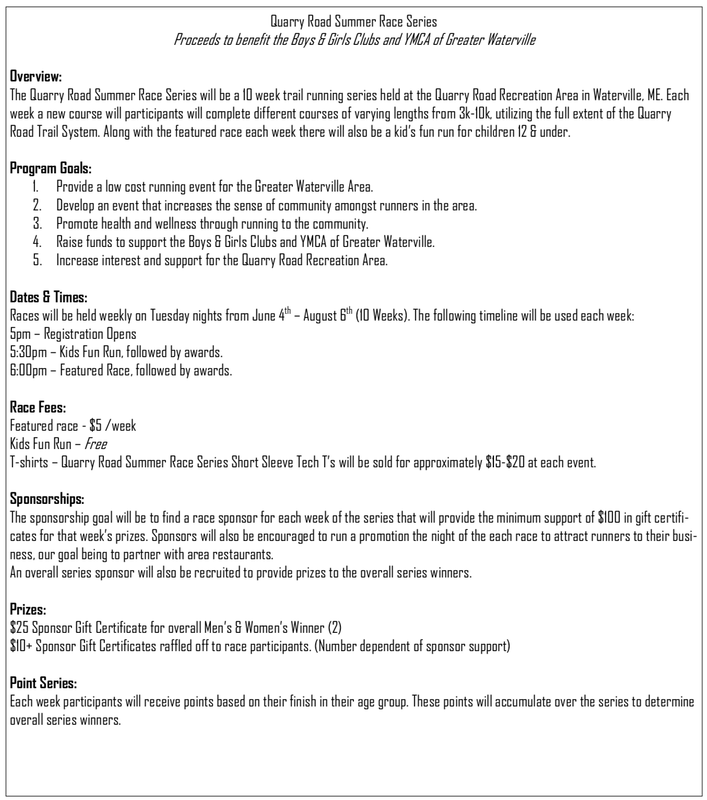
​- Lastly, an outline of Patrick's plans for the summer race series to be held at the Quarry Rd:
Picture
Picture
Picture
Picture
Picture
Picture
Picture
Picture
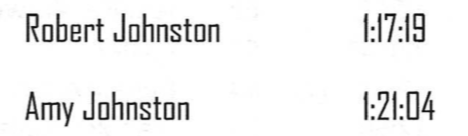
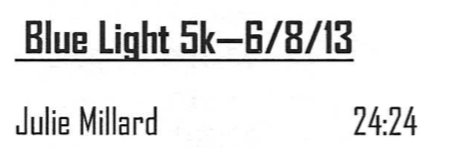
More than 100 runners showed up to the Joseph's 5k in Fairfield.  Five of those runners are current Striders:  Harold Shaw, Maria Bickford, Susan Brooks, Doug Brooks, and Jim Moore.  Strider Julie Millard was the race director. 

[Editor's note:  Julie told me that she likes race directing almost as much as she loves running Mount Washington and ultra-marathons.]

Picture
Picture
Picture
Picture
Picture
Picture
Picture
Picture
Picture
Picture
Picture
Picture

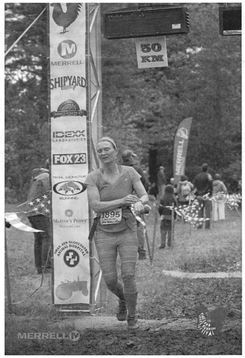
Julie Millard finishes her first (and only) ultra.
Picture
Picture
Picture
Picture
Picture
Picture
Picture
Picture
Picture
Picture
Picture
Picture
Picture
Picture
Picture
Picture
Picture
Picture
Picture
Picture
Picture
Picture
Picture
Picture
Picture
Picture
Picture
Picture
Picture
Picture
Picture
Picture
Picture
Picture
Picture
Picture
Picture
Picture
Picture
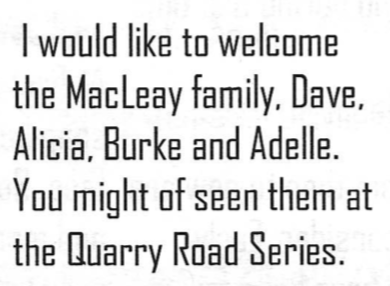
It looks like the MacLeay family joined the Striders in 2013:
Picture
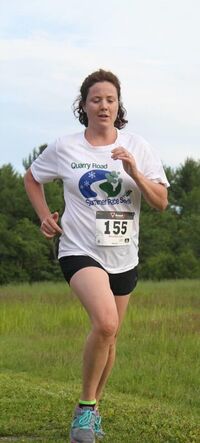
And you "might of seen" that Alicia was the first placed woman and 2nd overall runner in that year's Quarry Road Race Series and also ended up becoming the Strider's Communications officer from 2015 to 2018.
Picture
Picture
Picture
Picture
Picture
Picture
Picture
Someone made this design for a 2014 Striders shirt.  Not sure who designed it or whether any of the shirts actually were made (since strangely enough, I don't recall ever seeing anyone wear one).
Picture
Picture
Picture
Picture
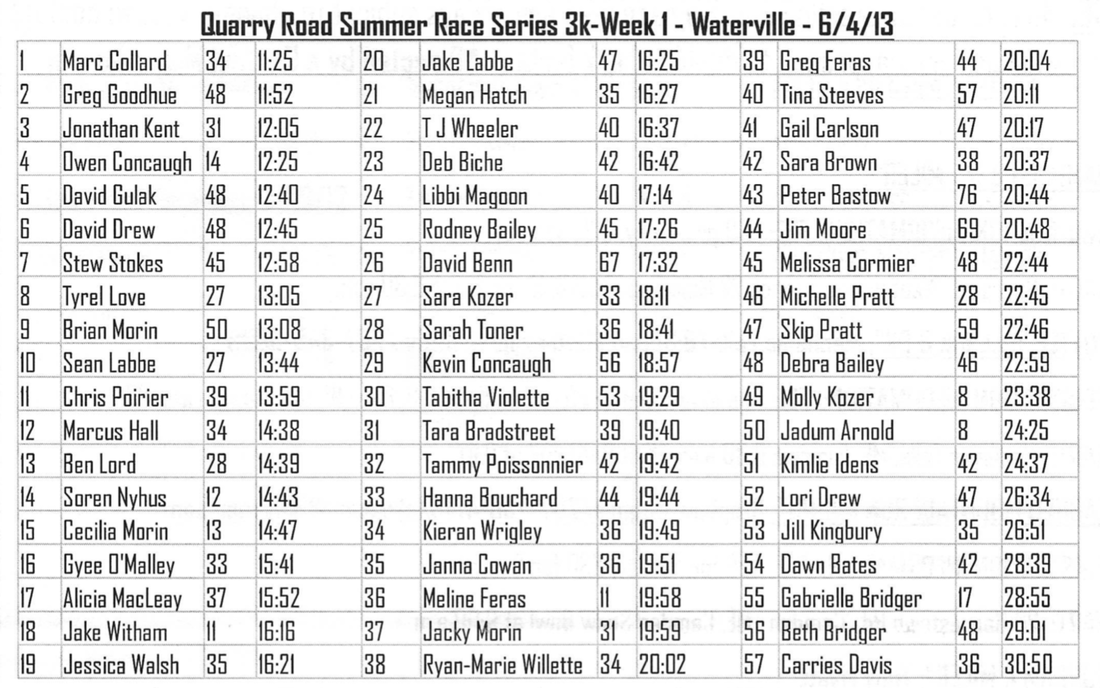
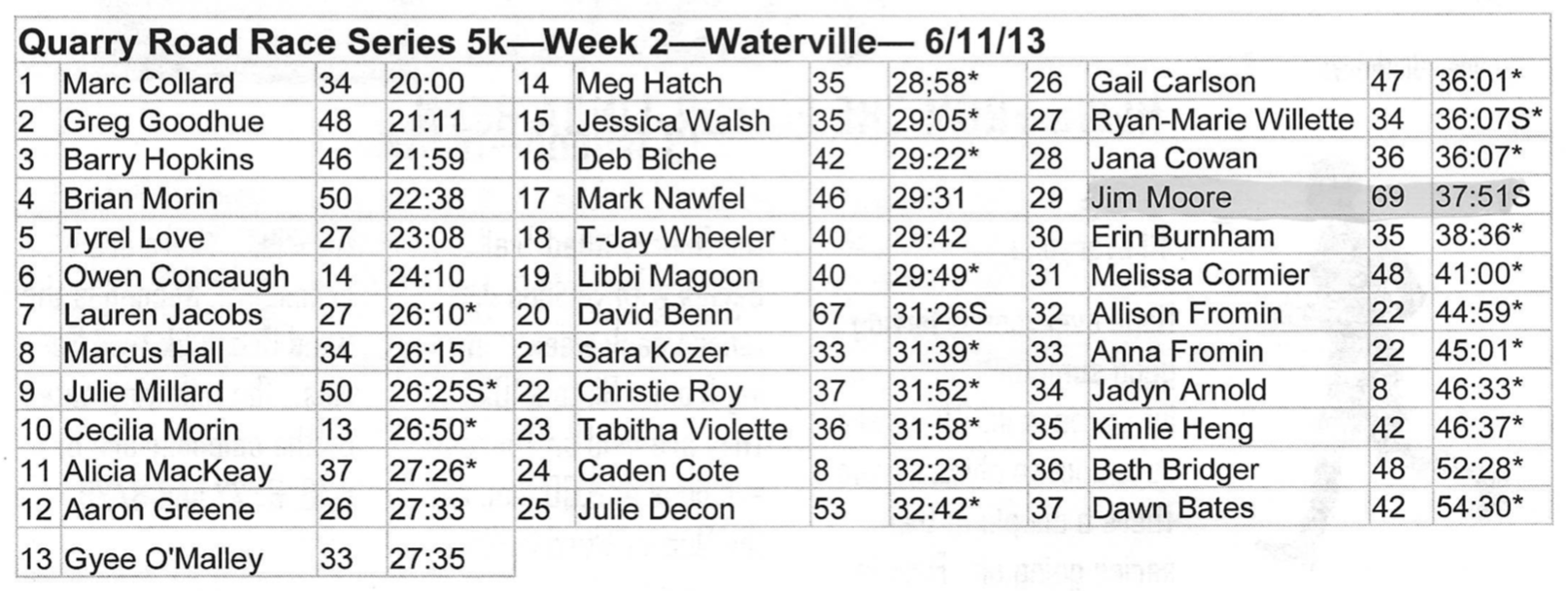
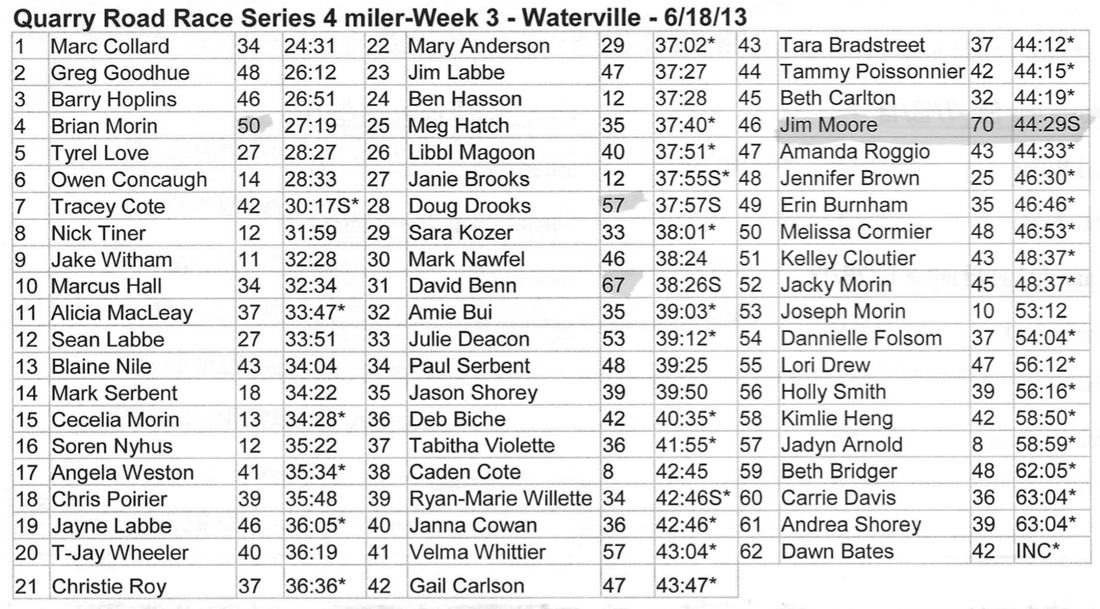
And then in the May 2013 newsletter, the start of the Quarry Road Summer Race Series was announced.  Although it seems that there have been some minor changes to the format, the series is still going today.  As far as I know, no one misses the 10k races that were part of the series the first year.
Picture
Picture
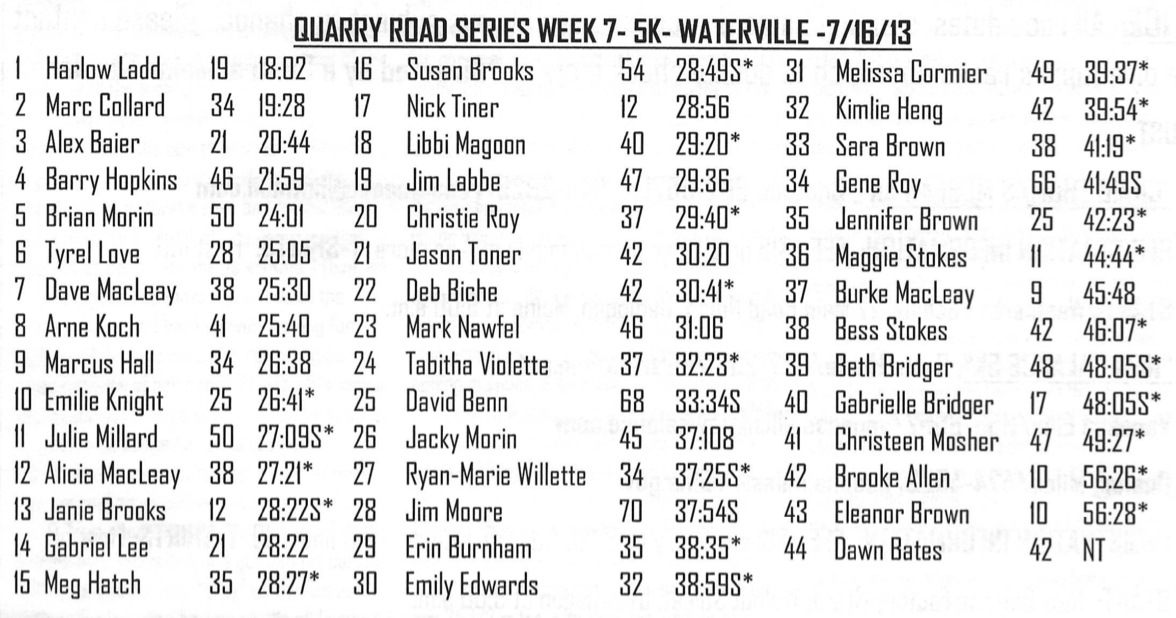
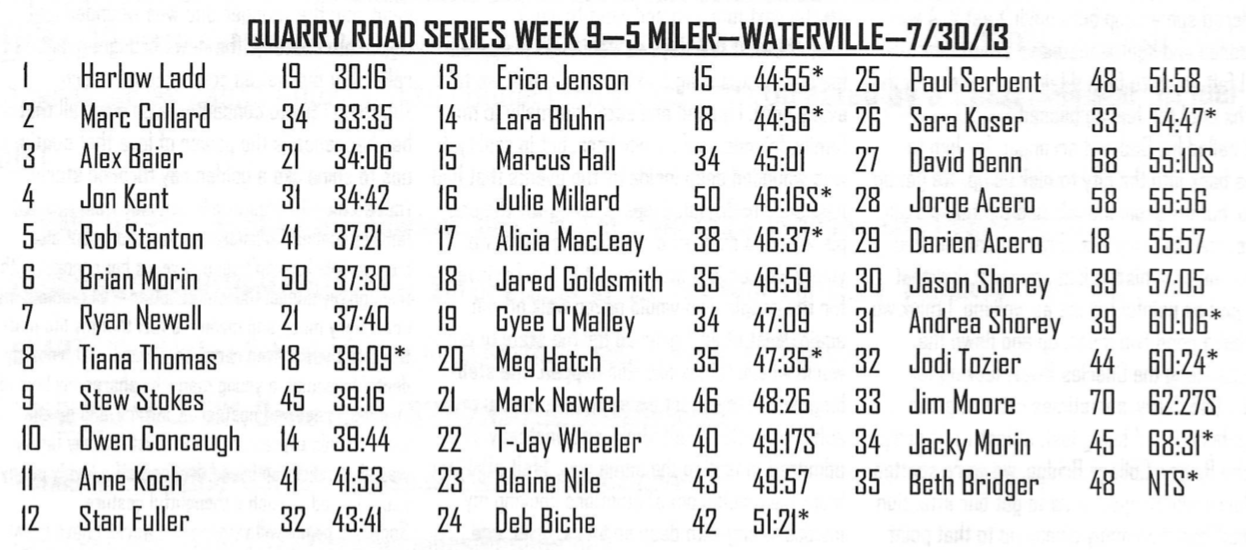
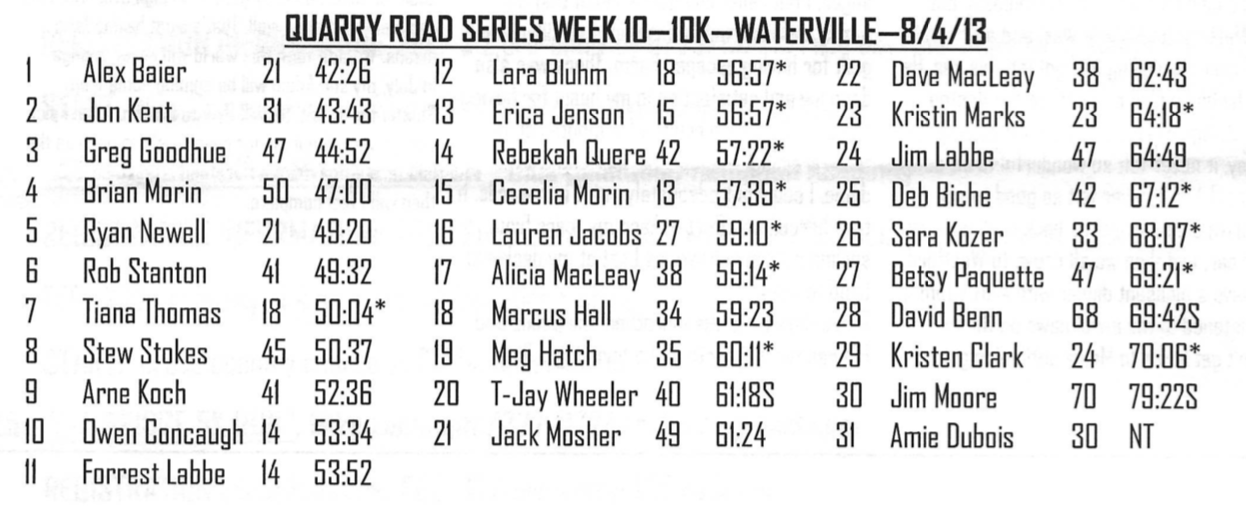
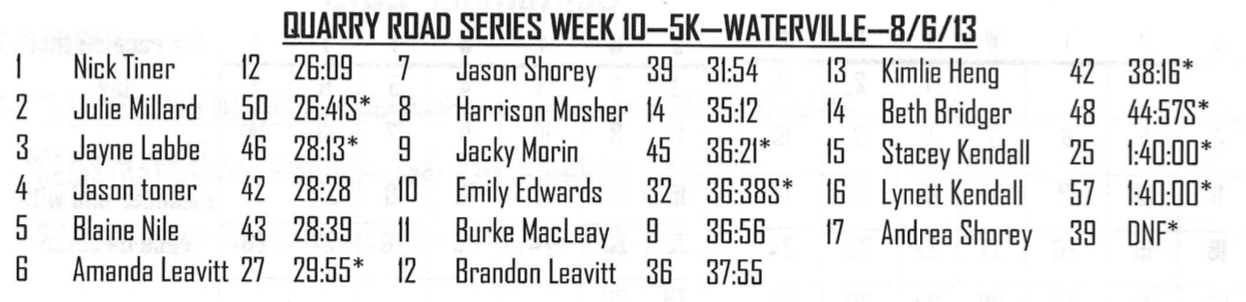
If you'd like to see the full results of the Quarry Road series from 2013, scroll down to the bottom of this flashback article.
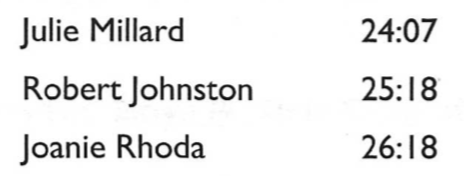
The June 2013 Interval featured a front page race report from Julie Millard about her first Ultramarathon.
Picture
Picture
Picture
Picture
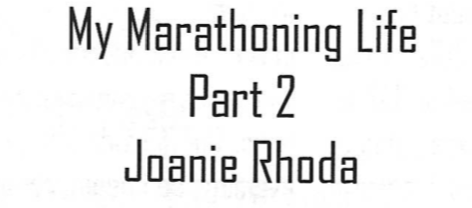
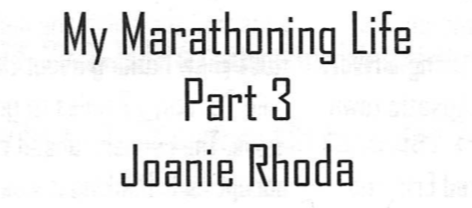
The July and August issues of the newsletter featured "My Marathoning Life, Parts 2 and 3" by Joanie Rhoda, which described her experience of qualifying for the Boston Marathon at the age of 59 and then running 25 miles of the 2013 Boston Marathon before the course was shut down due to the bombing near the finish line.  I found these articles to be heartwarming, inspiring, and heartbreaking.  I decided to reach out to Joanie as part of our "Catching Up With The Pack" series, which you can read here.  I've also published the full articles of "My Marathoning Life", Parts 2 and 3, as well as her article from 2012 called "Marathoning Then and Now" (which I assumed was the "Part 1" of this series).  You should really click on that link and read all three articles, as well as Joanie's updates on what she's doing now.  Just in case you missed the link the first time, here it is again:  click here

[Editor's note:  I wanted to publish her articles here, but as you can tell this flashback article is already getting really long]
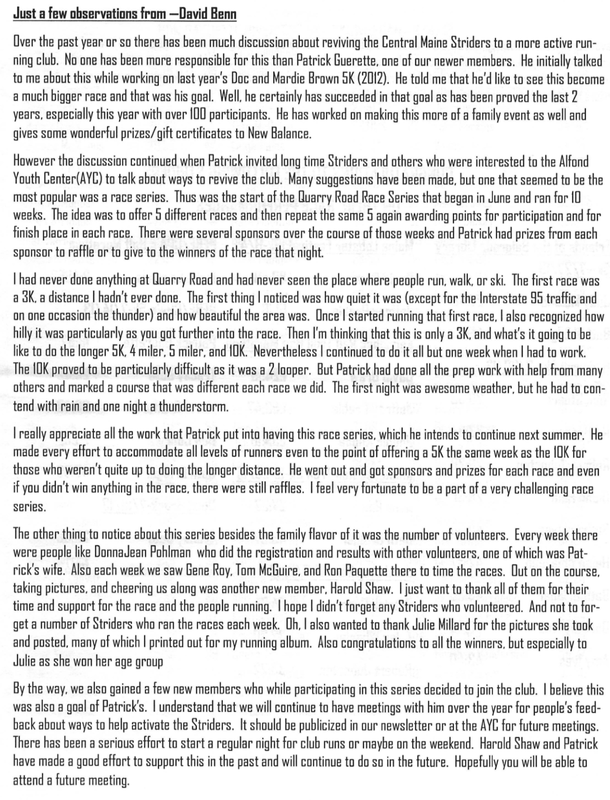
Buried in the middle of the August 2013 newsletter was this article of "observations" from former club president David Benn regarding reviving the Striders into a more active running club.  It gives some interesting insight into where the club was back in 2013 and how significant the revival was that year.
Picture
From the September 2013 issue of The Interval:
Picture
Picture
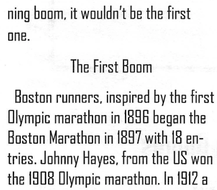
Gene went on in quite a bit of detail about what he described as the three booms of running.  The first was roughly 1896 to 1929; the second started in the early 1970's and included mentions of famous American runners like Frank Shorter, Bill Rodgers, Steve Prefontaine, and Maine's most famous runner, Joan Benoit; and the third boom being "now" (or around 2013 when the article was written.

I'd love to be able to reprint Gene's fascinating whole article here, since it has a lot of interesting historical running information, but I'm trying to keep this feature from running into novel length and trying to keep the perspective narrowed to the Central Maine Striders and not the running world at large.
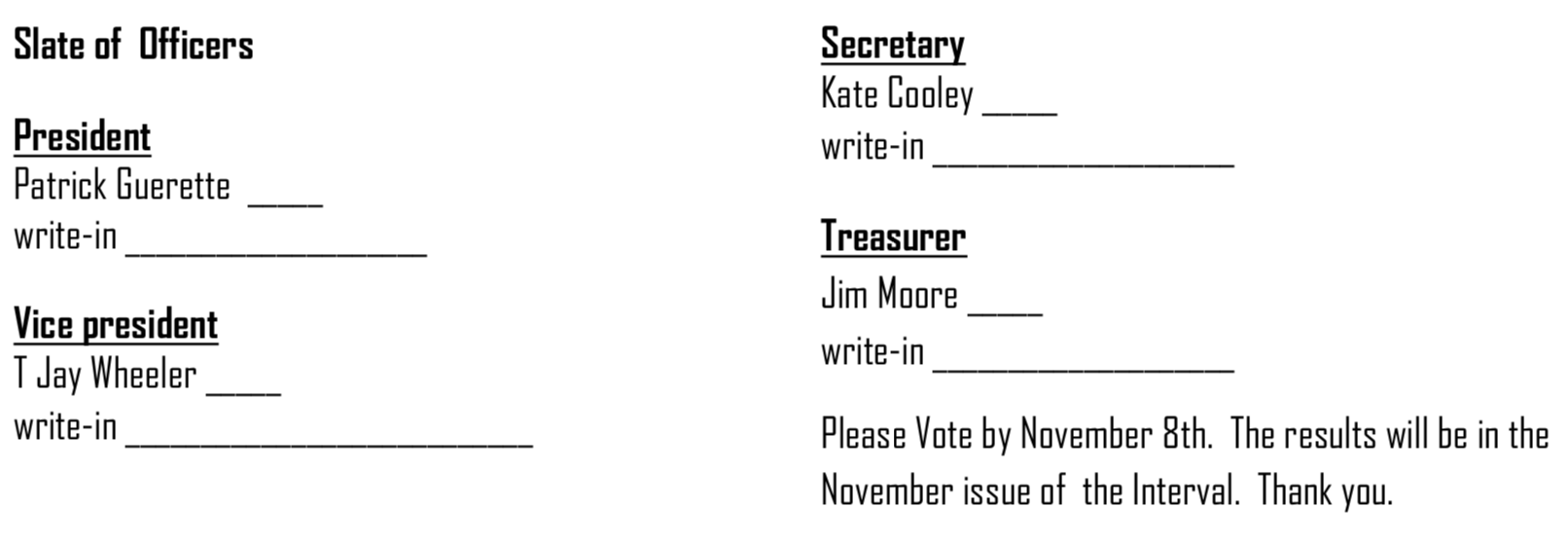
By October 2013, the revival was the Striders was starting to find some structure.  Officers for the next year were nominated and a ballot was included in the newsletter.  As is the tradition, none of the officer positions were contested.
Picture
Picture
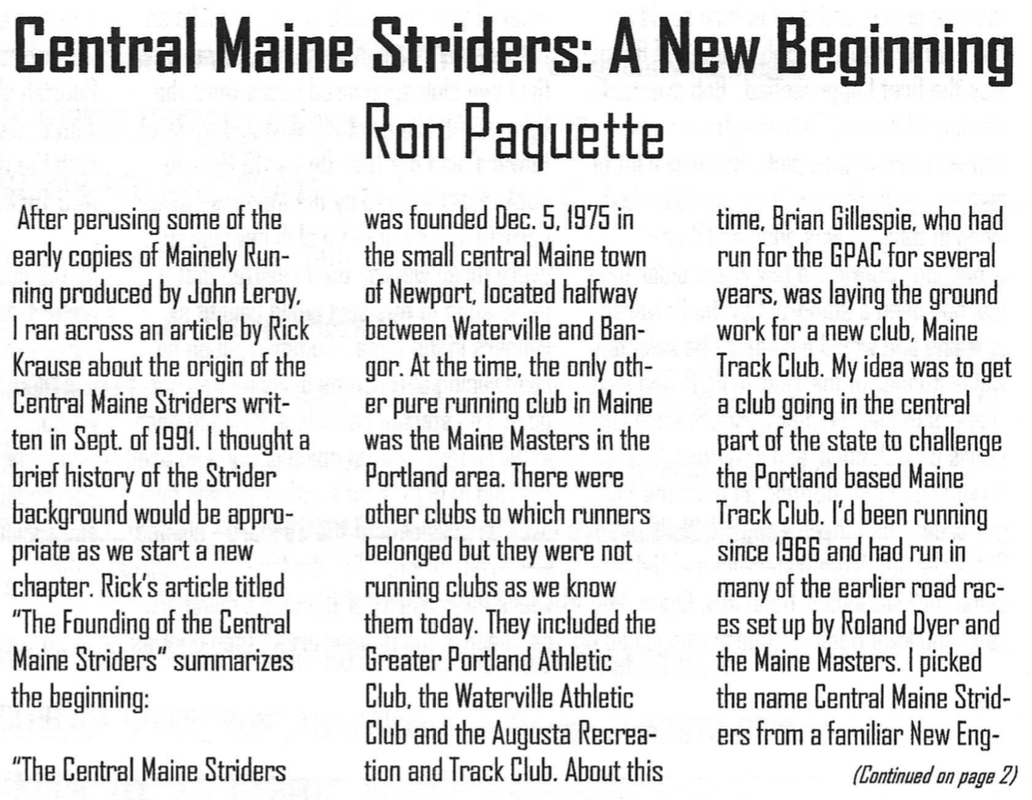
In November of 2013, longtime and still very active member Ron Paquette dug into the Striders history by finding an old piece by Rick Krause about the founding of the club.  I'm really glad to have found this article by Ron and would love to find more about those early days of the club.
Picture
Picture
Just to reinforce what Ron said in the end of that article: "As the new group of enthusiastic officers embark on the challenge of this new chapter of the Central Maine Striders, let's all join them by giving them all the support that we can.  Volunteering, participating, and recruiting will be a great way to show our appreciation - whether you are in for fun and socializing, health benefits, or the competitive spirit - GET INVOLVED."  No truer words have ever been spoken about what it takes to keep a club running through years.
And by the end of the year, the new officers for the club were made official:
Picture
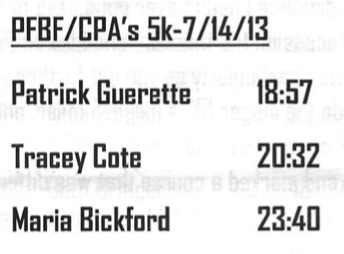
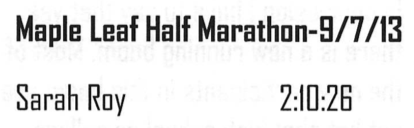
And here are the full results from the first ever Quarry Road Summer Race Series, as published in various issues of The Interval that year:
Picture
Picture
Picture
Picture
Picture
Picture
Picture
Picture
Picture
Picture
Picture
Overall series winners included current CMS members:

​Overall Male:  Brian Morin
Overall Female:  Alicia MacLeay
F 18 & Under:  Cecilia Morin
F 50 & Up:  Julie Millard

In total, 195 different runners participated in at least one Quarry Road Race that summer.  Sounds like it was a success!

Congratulations for making it to the end of another marathon jog through the Central Maine Striders archive.  Sometimes, you never know where running backwards can take you.  Although, I recommend you run forwards in all cases not related to reading articles about the history of the Central Maine Striders.
Published on
Image description
In case you haven't heard, the Quarry Road Summer Race Series is happening again this year, albeit in a slightly different format due to the unique nature of the pandemic world we're living in right now.  Just in case you didn't know about it yet or if you just want to get more information, Patrick Guerette (the founder of the event) sent along this message: 

COVID-19 has really crushed the local racing scene this summer, which is one reason why I am thrilled that we were able to land on a racing format that provides an option for runners to compete. Not only are the courses just as challenging, time trials also add a unique mental test to the race, as it's much easier to push yourself when you are trying to close the gap on another runner, or running scared. Simply put, if you are able to push yourself on a solo effort, it will make you a stronger runner & racer in the future. 

With nearly 60 runners signed up to run this summer, and over 40 finishers in each of the first 2 weeks we have exceeded our original expectations for the series this summer. With that said, if you are not signed up for the series yet, it's not too late, there are still options to register for 1, 3 or all 9 (6 remaining) races by clicking here

After the first 2 weeks, it looks like there will be quite a few closely contested age group battles, which adds a bit of excitement to the race series, if you want to keep up on the results, we invite you to view our race results and standings online here.

See you on the trails!

-Patrick Guerette

Bonus Question:  Do you know what year Patrick organized the first Quarry Road Race Series?
Bonus Information:  As a paying member of the Central Maine Striders, you'll automatically get 10% off your registration for the Quarry Road Race Series.


Published on
Image description
"Meet Our Members" is where we get to know a little more about our fellow Striders -- who they are, why they run, and why they're part of the Central Maine Striders.

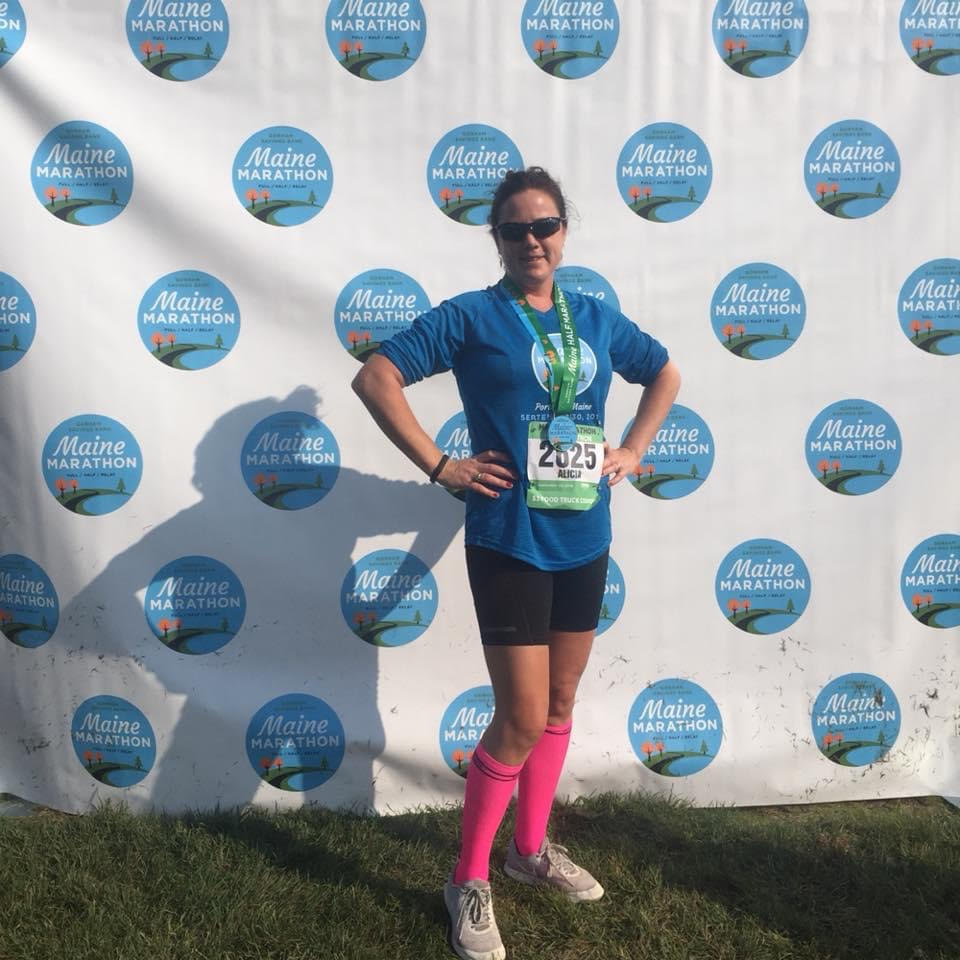
Alicia Wilcox is a mother of 13-year-old twins and an associate professor at Thomas College.  She teaches forensic science and criminal justice classes.  She also has a forensic consulting company and likes to garden, travel, and hike.  

"I started running in the summer of 2014 at age 36. I was in the middle of my PhD program and expressed my feelings of stress to a friend. She was training with another woman for the Maine 1/2 marathon. They intended running a long run of 8 miles that weekend. I said I would join them for two or three miles. I ended up running the 8 miles with them and felt great. A few weeks later I applied for a cancellation spot in the 1/2 marathon and got in. I completed that 1/2 in under 2 hours with very little training.

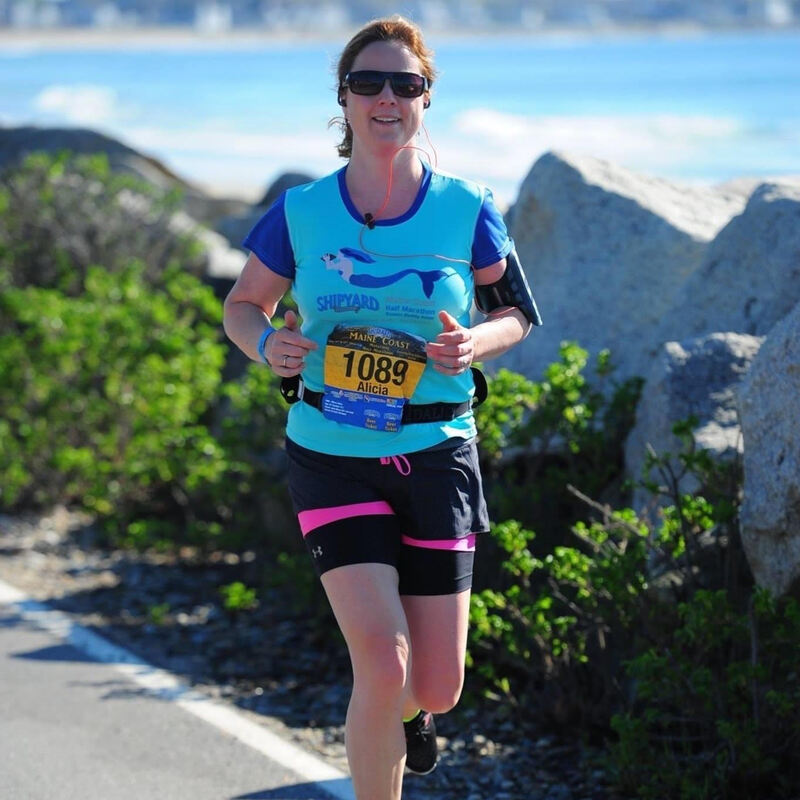
I was hooked and running helped me through the stress of my PhD. I have since completed 16 half marathons, my most recent was the Shipyard Maine Coast Half, which was virtual, meaning, I ran by myself!

The women I used to run with don't run anymore. So this year I decided to join the Central Maine Striders to make new running friends. I participated in the January Thaw and ran with a small group one Sunday morning before the pandemic struck. I look forward to meeting new striders in the future. At the moment I am running the quarry road series and a 312K series Baxter to Baxter (from the state park to Baxter Brewing, in Lewiston). 

I love the simplicity of running, all you need is a good pair of sneakers and some happy music."

Alicia, we're glad you're a Strider and hope to see you and get to know you at more Strider events in the future, whenever we're able to hold in-person events again.
Picture
Picture
Published on
The Central Maine Striders are proud to have several active members that have been with us since the early days of the club.  One of those members, whose name you may recognize from our latest Running Backwards article, is Gust Stringos.  Since he was featured under the "New Members" section back in 1983, we thought we'd reach out to him and get an update.  Here's what he had to say:

I am 65 now, and live in the same house in Skowhegan!  I did run the Maine Coast Marathon, with a time just under 3:05, not enough to qualify for Boston.  I did continue my medical training, and have been a family practice physician in Skowhegan for 30+ years, and am currently Medical Director of Redington-Fairview Hospital here.  I still enjoy gardening and Beekeeping.  Two years ago, I tore a hamstring muscle in a skiing accident, and my competitive running has taken a big hit as a consequence, but I still try to get in 2-3 miles several times a week.  And I am still proud to be a Central Maine Strider!

Gust, we're proud to have you as a longtime member as well.  Thanks for giving us an update!

Published on
This month we're running way back to 1983, the semi-historic year when the Interval was first "computerized".  Check it out!
Picture
Either the archives are missing the January and February 1983 issues, or no Interval was made in those months.  There was an invitation for the Striders annual banquet that was sent out in January, but that seems to barely count as an issue of The Interval (the greatest central Maine-based running newsletter over the last 40 years or so).

However, the March issue featured a major Striders announcment -- the club entered the COMPUTER AGE!
Picture
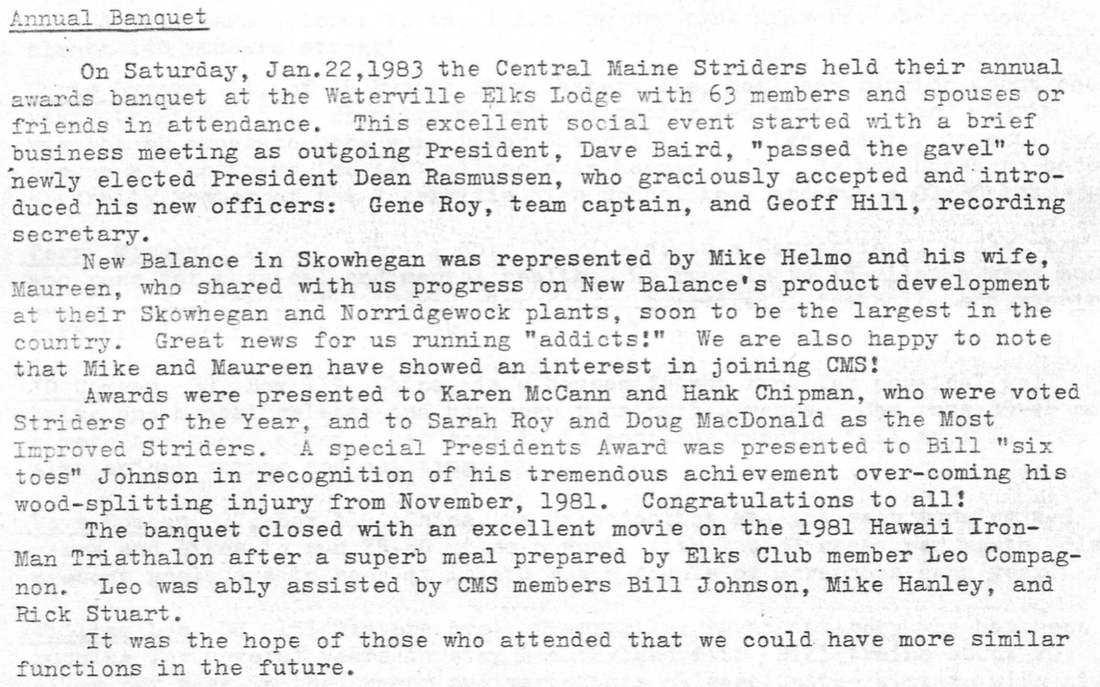
Back in 1983, the Striders' annual banquet seemed like a pretty impressive affair.  63 people attended!  The newly elected board of officers included Dean Rasmussen, Gene Roy, and Geoff Hill (all of whom are still active members to this day).  Current member Sarah Roy won an award for Most Improved Strider.  The 1983 club even had a New Balance representative speak at the banquet!  And they ended the banquet with a showing of a movie about the 1981 Hawaii IronMan Triathlon (remember, this was long before Netflix or even DVDs existed).  Sounds like it was a pretty exciting night.
Picture
The January Thaw Road Race was postponed that year due to bad weather.  Geez... that never happens in Maine in January.  Oh wait, (...checks January Thaw archives...) it happened this year and last year.  
Picture
I usually don't include old finance information in these flashbacks, but the balance of $96.53 from February 2, 1983 has to be the lowest that I have ever seen the club's balance get, and I'm guessing that all of the current and former club Treasurers would agree. 
Picture
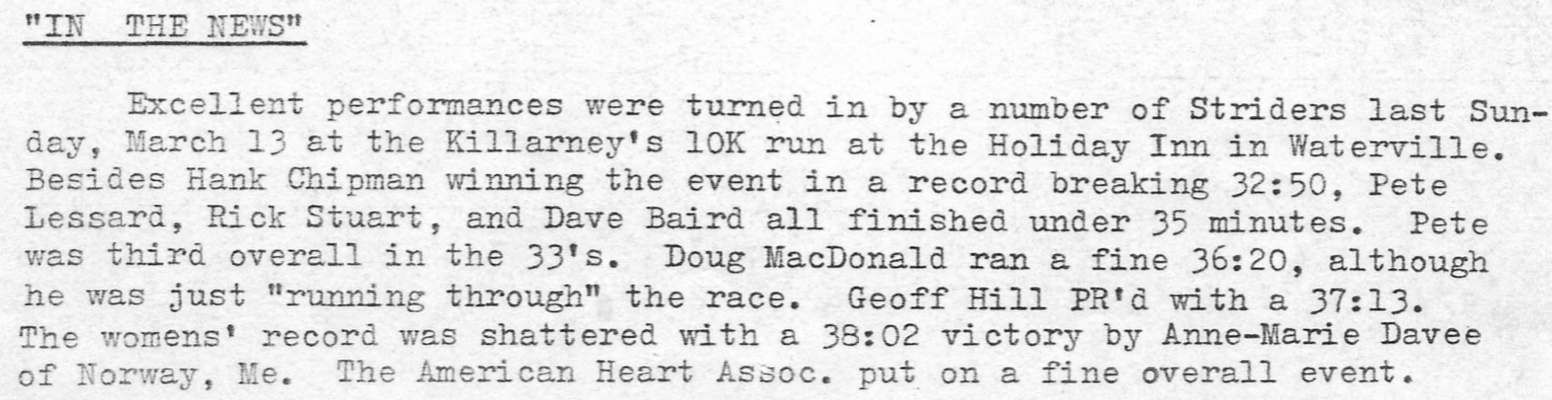
The April 1983 newsletter included coverage of that year's Killarney's 10k, which saw a new course records set for both the men and the women.  Current member Rick Stuart ran sub-35 minutes.
Picture
Picture
It turns out that Fred Judkins wasn't using just any computer for the new Striders member database.  He was using an all-caps APPLE computer.  Fancy stuff.  [As a side note, I think I got my first computer, an Apple IIe, around that same time]
Picture
It seems that the city of Auburn tried to pass an anti-joggers and skiers law.  No word on how a law against joggers and skiers would affect runners.  Also, how often were people skiing down the side of the road an actual problem?  I know this is Maine and all, but..... really?  
Picture
In the May 1983 Interval, the newsletter editor announced that they were going to start profiling one member each month, selected at random.  [The 2020 newsletter editor is thinking about implementing this "random" method to choosing members to profile in the "Meet Our Members" section.] 
Picture
They were also looking for articles from members [Another note from the 2020 editor:  Time may have moved forward by 37 years, but we're still looking for article from members.  If anyone would like to help out by writing an article for our newsletter and webpage, send an email to run@centralmainestriders.com.] 
Picture
And, they were looking for someone with a copier that could copy onto both sides of paper.  [The 2020 editor would like to let you know that we are no longer searching for two-sided copying capabilities.]
Picture
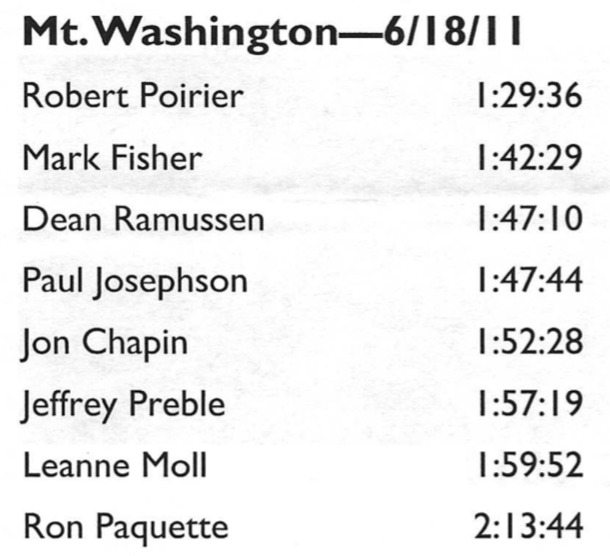
Gene Roy was looking for Striders to join him for a Mount Washington road race team.  This was the year that Ron Paquette and Dean Rasmussen succumbed to Gene's pleas to get a Striders team for this uphill race.  Apparently,  they've been addicted to that hill since that year, considering that they've ran it every year from then until now.  As you all know, the race has been cancelled this year due to concerns surrounding the COVID-19 pandemic.  Let's hope these two fine gentlemen get a chance to continue their streak next year.
Picture
It's hard to believe that a couple Striders in 1983 ran the London Marathon, but that's exactly what Susan Adams and Linda Snow did.  This was only the third year that the London Marathon was run.  Unfortunately, these two women are no longer members of our club, but I'd love to hear where they are now and if they're still running.

In other "international" news, there were some Striders preparing for the Boston Marathon.  Rick Stuart was gunning for a sub-2:30 marathon and Geoff Hill was aiming to be a bandit.
Picture
Rick Stuart primed his way to the Boston Marathon by capturing 7th place in the Readfield Boston Primer 15-miler.  That must have been quite the field if Rick only got 7th. 
Picture
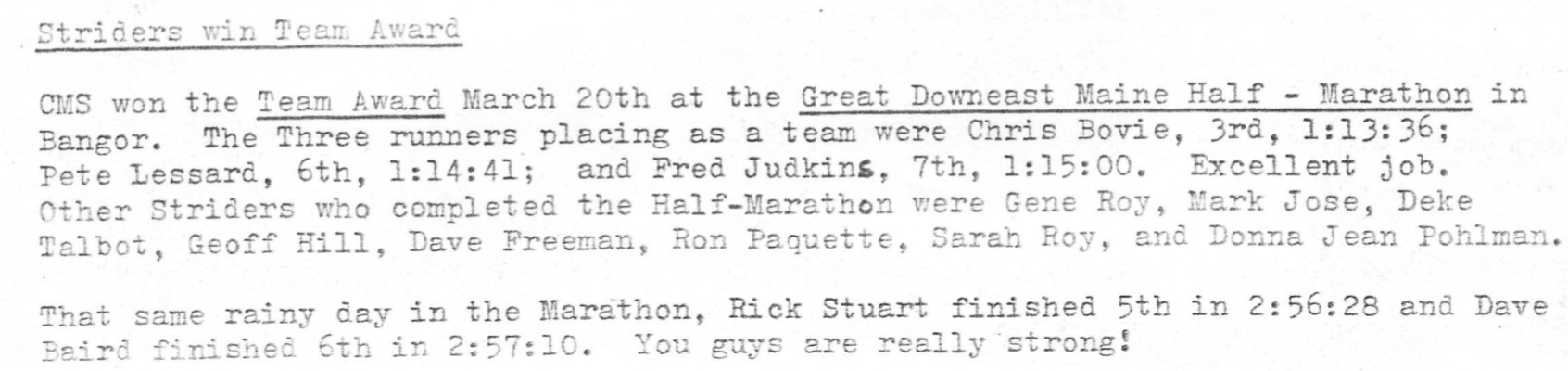
The Striders fielded a stellar team for the Great Downeast Maine Half Marathon back in 1983.  The team featured long-time Strider all-stars Gene Roy, Geoff Hill, Ron Paquette, Sarah Roy, and Donnjean Pohlman.  Not to be outdone, Rick Stuart finished 5th in the marathon that day with a nice sub-3-hour time.  Wait... I thought Rick was preparing for Boston.  [Editor's Note:  He was.]
Picture
In the "New Members" section of the May 1983 newsletter, none other than current member Gust Stringos was introduced.  Gust did run the Maine Coast Marathon that year, and still enjoys beekeeping and gardening.
Picture
Picture
By June of 1983, it seems that Fred Judkins was getting into his APPLE computer.  Based on the amazing font seen below, it looks like he started using the computer for typing newsletters, besides just keeping a member database.  Also, it seems like this issue marked the point in time where the club found a way to print/copy on both sides of a piece of paper.

Oh, and you gotta love the very dated title "Data Processor".
Picture
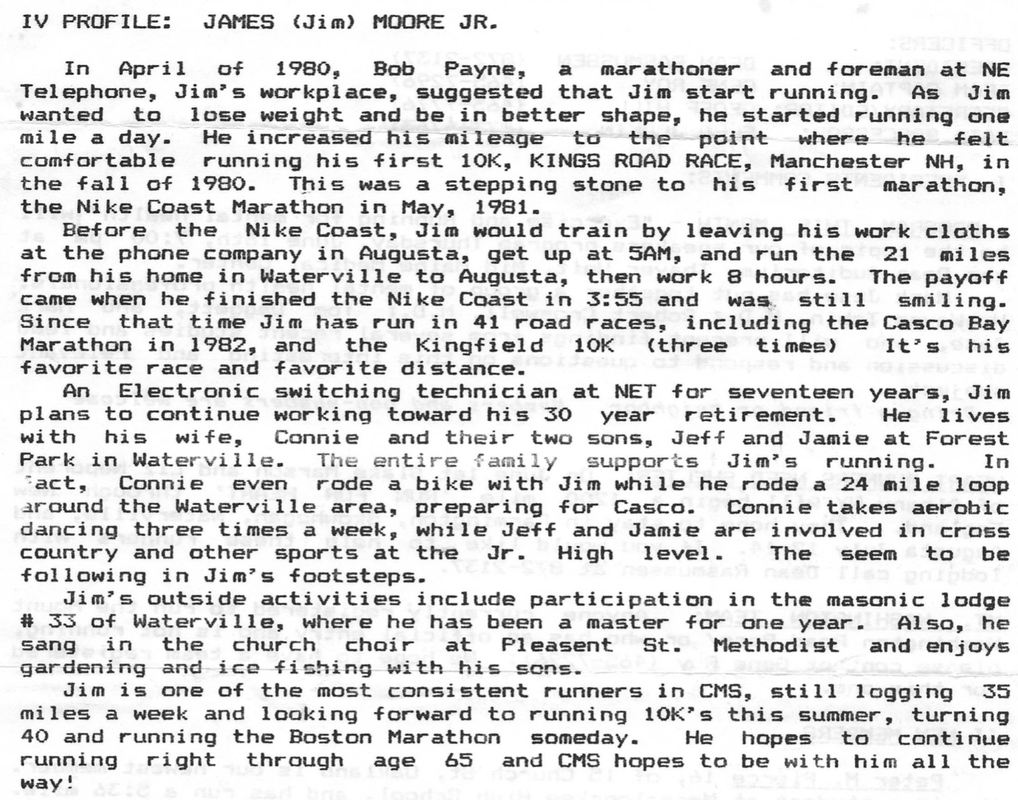
That same issue featured a profile on longtime member Jim Moore.  37 years since this article was written and Jim is still probably one of the most consistent runners in CMS.  Jim, I think you've made your goal of continuing running through the age of 65 and we're extremely thankful to have been with you the whole way!  Also, has anyone else out there commuted to work in Augusta by running the 21 miles?  Now, that's dedication!
Picture
It looks like Rick Stuart didn't make his sub-2:30 goal at Boston, but 2:37 ain't too shabby!
Picture
Speaking of not shabby, Gene Roy ran a 22:13 at a 4-mile race in Portland.
Picture
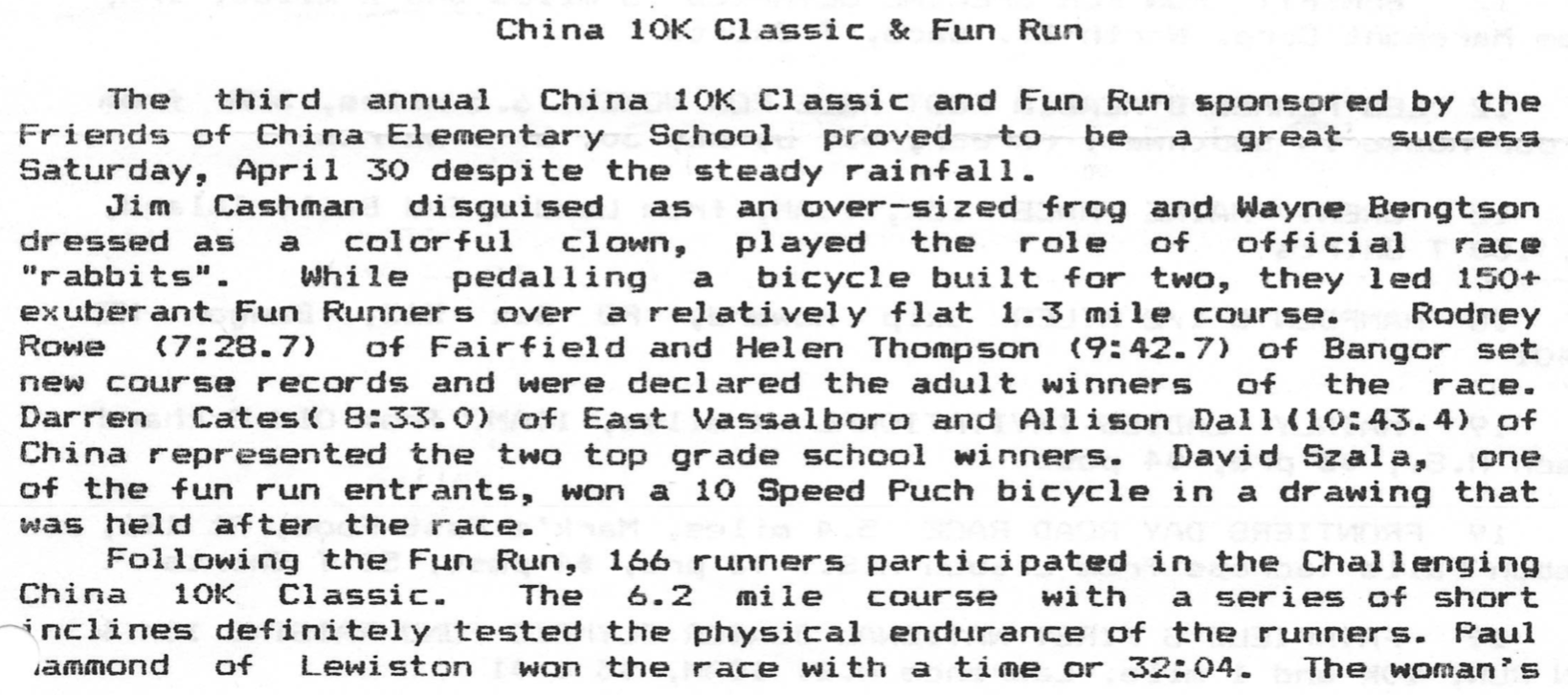
While Gene was running his 4 miles in Portland, it looks like a large chunk of the Striders membership was running a 10k in China.  Current members Geoff Hill, Jim Moore, and Donnajean Pohlman were listed in the results.
Picture
Picture
Picture
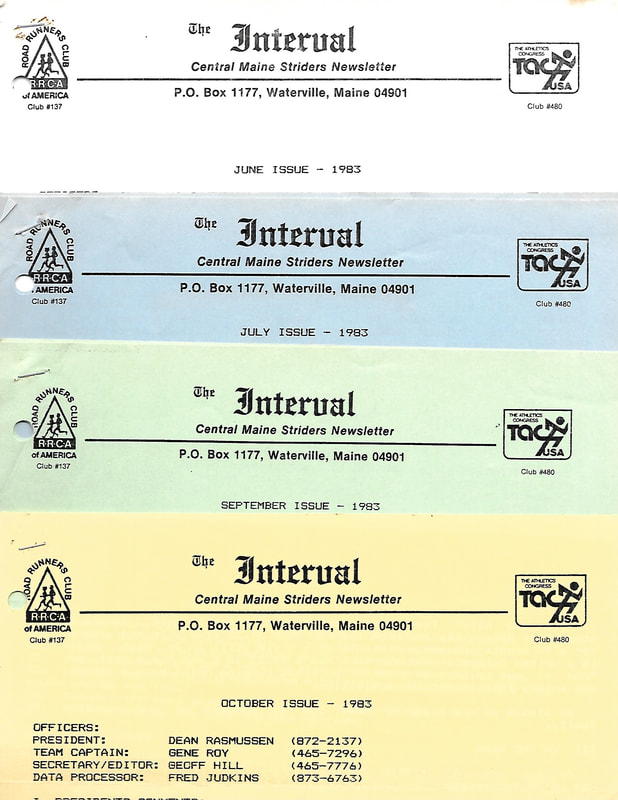
As the club's data processing and computerizing skills advanced, they started printing newsletters on colored paper.  The colored paper trend in the newsletter continued until 1993 or so. 

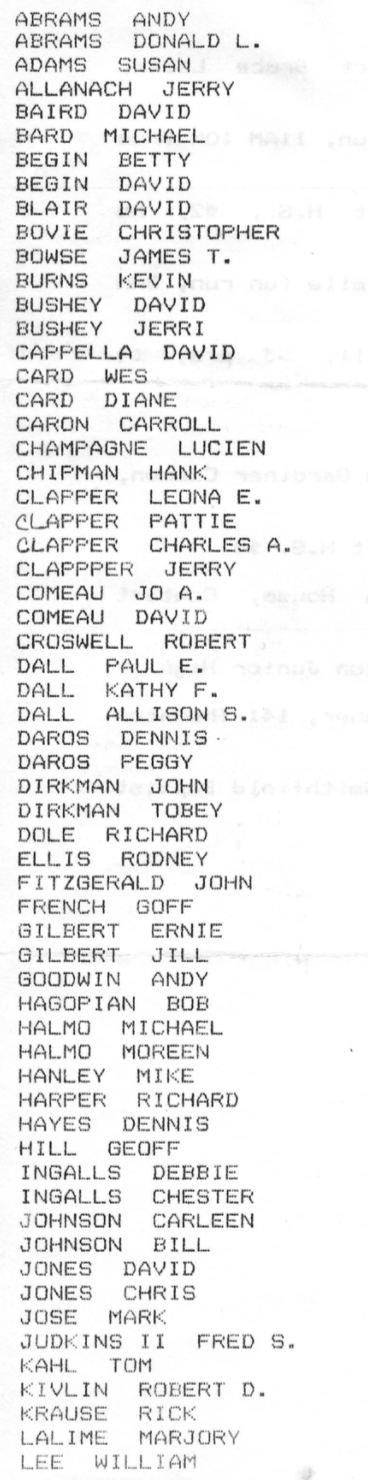
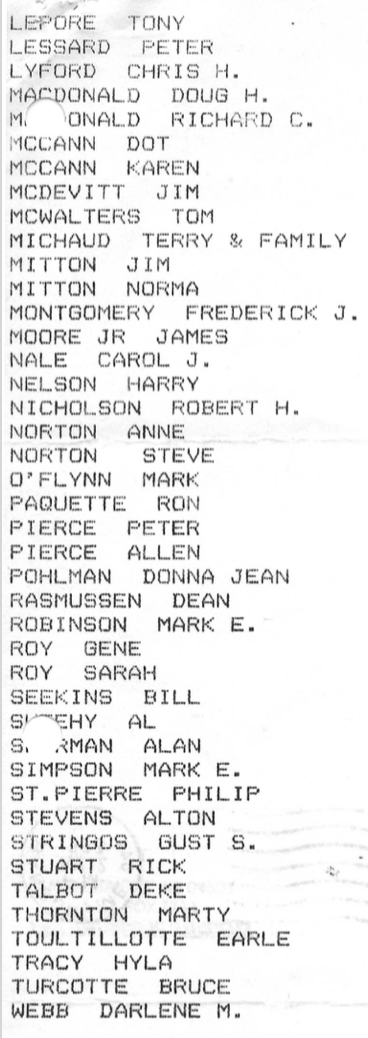
The June 1983 issue also included a list of all the current members, along with their addresses and phone numbers.  We cut off the contact info here, but are showing you the members' names.  We're very thankful for all the names that are on this 1983 list AND still on our 2020 member list.
Picture
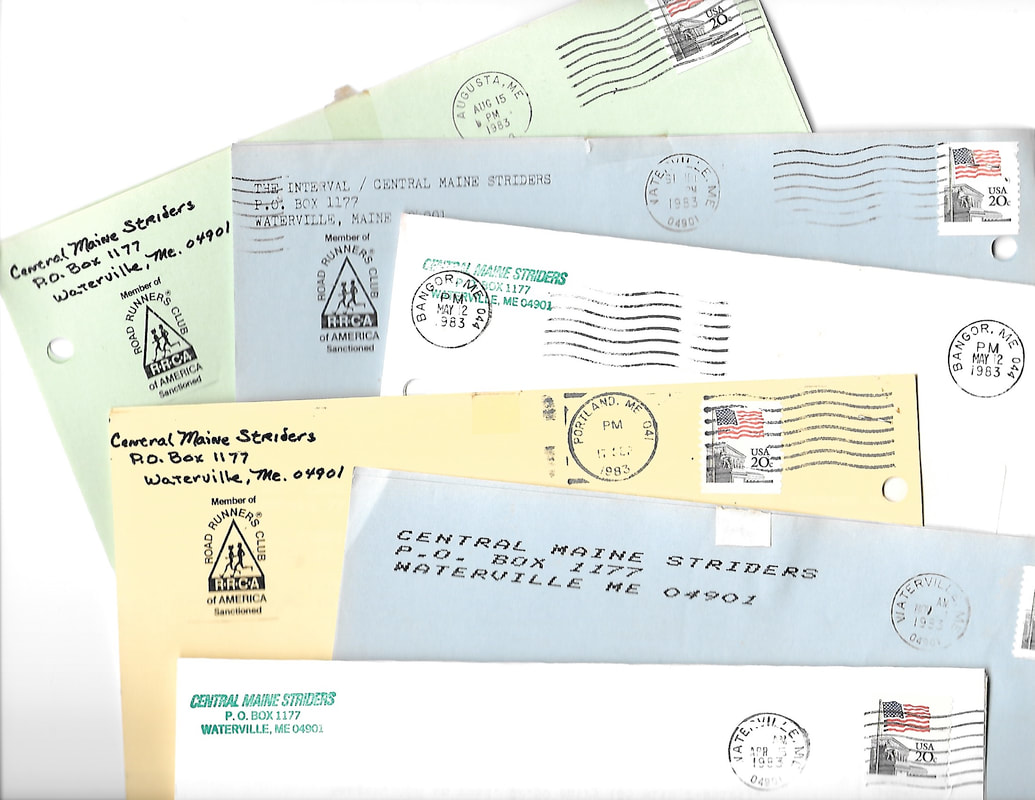
Besides switching around the color of paper that the newsletters were printed on, they also seemed to go through several iterations of how the return address was printed on them.  Perhaps even more surprising is how many different post offices across the state were used to mail these out.  Newsletters were postmarked in Waterville, Augusta, Portland, and Bangor that year.
Picture
Picture
Picture
There were some familiar names amongst two back-to-back Saturday 10k's in May of 1983.

At the Emden 10k, Rick Stuart came in second with a nice 5:36 pace.  Dean Rasmussen, Donnajean Pohlman, Ron Paquette, and Gene Roy also placed in the top 10.  No offense to Gene, but were there only 10 runners in this 10k?  The Striders held 8 of the top 10 places, and there was 14 minutes between first and tenth place.

Picture
The next weekend, there was a bigger turnout of not just Striders, but of runners period.  Our current club clerk, Alton Stevens, finished with an impressive 33:44 time.  Gene Roy avenged his last(?) place finish from the previous week by cutting nearly 13 minutes off his time.  We'll give Gene the benefit of the doubt and assume the Emden 10k was just a training run for the Boothbay 10k.  It's too bad, though, that his place dropped from 10th to 31st.  Numbers, places, and running can be strange like that sometimes.  Geoff Hill, Jim Moore, and Sarah Roy were also part of the large CMS contingent at the race.
Picture
Susan Adams finished the London Marathon in a time of 4:19.  No word on how Linda Snow fared.  She's also not included on the list of members from the June Interval.  Hmmmm...  conspiracy theorists could probably come up with a great explanation for this.
Picture
Gust Stringos, introduced to the club back in the May 1983 newsletter and still a club member, finished the Maine Coast Marathon in 3:04:55.  Jerry Allanach, another longtime Strider and current Chicago-area resident, came in at 3:18:06.
Picture
In the August issue that year, it was announced that the Striders would be hosting the 1st ever Sugarloaf Marathon.  Of course, along with that honor came responsibility, so they were asking for volunteers.
Picture
Results from the first year of "The One-Hill Streak" for Dean Rasmussen and Ron Paquette were also in that August issue.  Gene Roy and some other guys were also on the team, but had streaks that ended much earlier than 37 years.
Picture
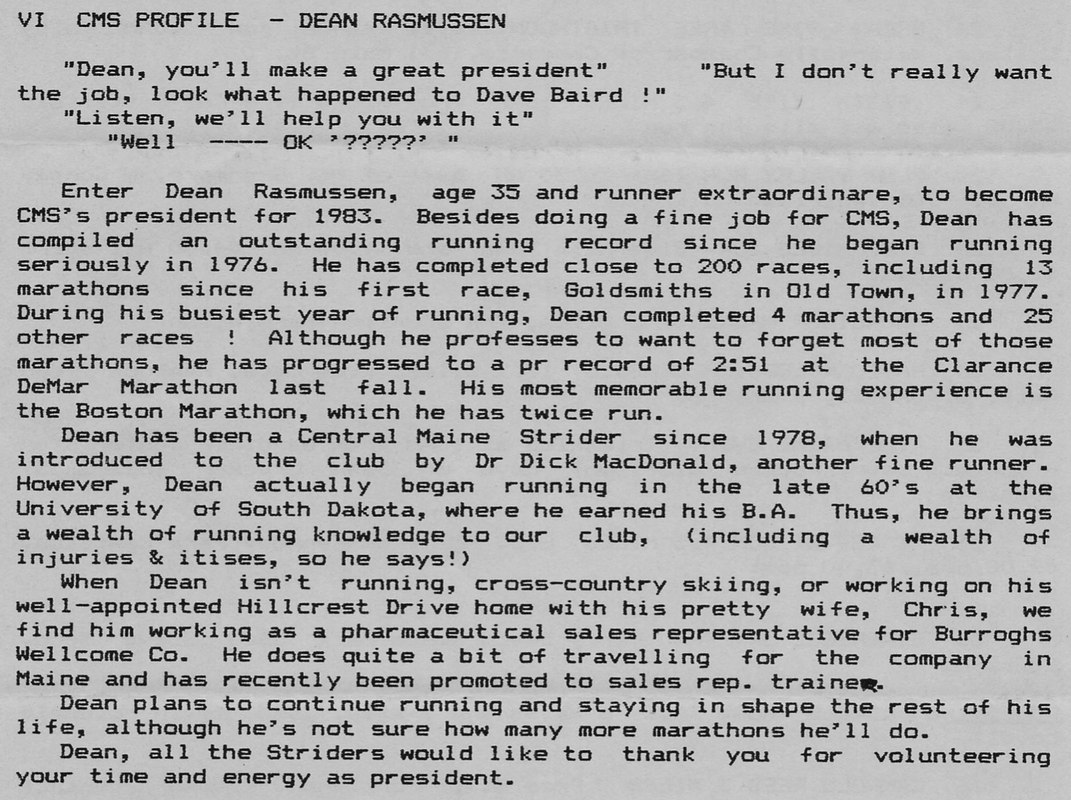
So, you may be asking yourself, "who is this Dean guy?"  Well, here's how he was profiled in that August 1983 Interval.  Dean, thanks for continuing to be a Strider for all of these years!
Picture
Rick Stuart ran a high-altitude 10k out in New Mexico that year.  Unfortunately, the Interval and/or the computer skills of the club weren't advanced enough to include pictures in the newsletter, so we'll never know whether the mentioned picture was a "real" road runner or if it was Rick.
Picture
Picture
In the President's Comments of the October 1983 Interval, Dean Rasmussen thanked all of the members that volunteered for the first Sugarloaf Marathon.  We all know that volunteers are probably the most critical component of a successful race.
Picture
That issue also included race results for several CMS members, including Donnajean Pohlman's sub-4-hour marathon in San Francisco.
Picture
Gust Stringos seems to have had a good showing at the Twilight 5-miler with pace just under 6-minutes-per-mile.  Ron Paquette and Donnajean Pohlman were also amongst the large group of Striders that ran the race in Skowhegan.
Picture
Those same three current Striders ran another race in Skowhegan that month and were joined by Sarah Roy and several other members.
Picture
The only current Strider to be listed in the results for that first Sugarloaf Marathon was Dean Rasmussen.  He grabbed 14th place overall with a nice sub-3-hour finish.  However, the date in these results was listed as 1982, even though the first Sugarloaf Marathon was held in 1983.  Hmmmm..... do we have another conspiracy theory here, or was it just an innocent typo on an old APPLE computer?
Picture
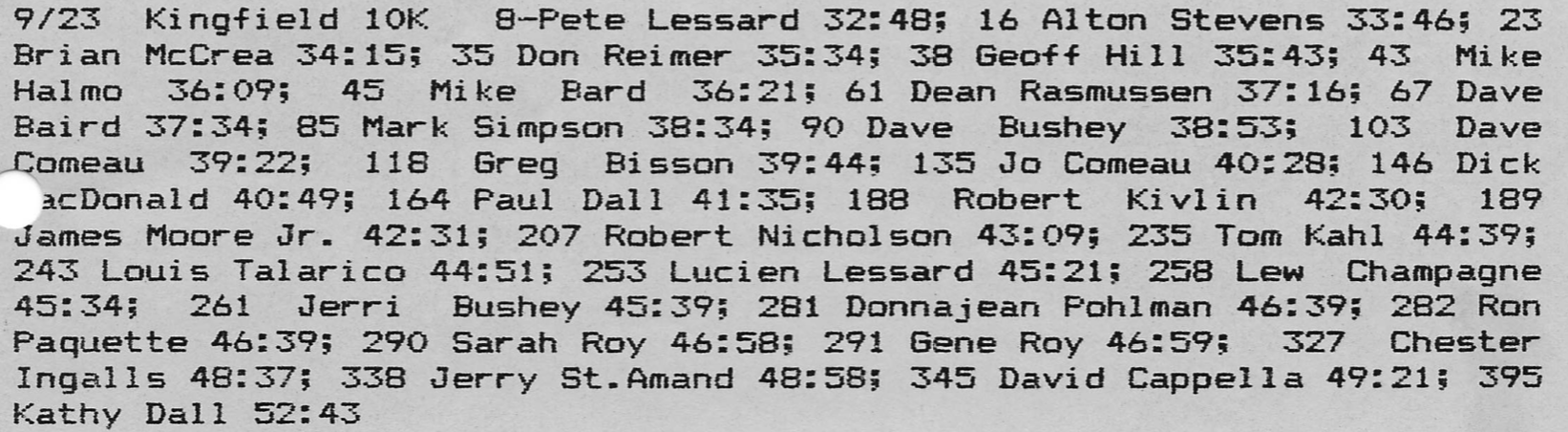
A month later in Kingsfield, a giant group of Striders showed up for the Kingfield 10k.  Alton Stevens, Geoff Hill, Dean Rasmussen, Jim Moore, Donnajean Pohlman, Ron Paquette, Sarah Roy, and Gene Roy were all there.  Ron and Donnajean beat Gene and Sarah by about 20 seconds for the title of "top Striders couple".
Picture
The Kingfield and Sugarloaf area continued to be a popular area for Striders to race in that fall, with another big group running the Sugarloaf Uphill race.  Gene Roy grabbed 6th place overall with a finish time of an even 32 minutes.  Usual suspects Geoff Hill, Dean Rasmussen, Ron Paquette, and Jim Moore also finished the uphill race.
Picture
In October 1983, Geoff Hill ran the Casco Bay Marathon with a nice time of 3:12:32.
Picture
And in November 1983, CMS member Chris Bovie tied a course record at the Veterans Day 5k with a time of 16:04!  Geoff Hill came in 6th with a time of 18-minutes flat.  Gene Roy and Jim Moore opted for the half marathon that day and finished with times of 1:24:40 and 1:33:17, respectively. 
Picture
Ok, that's 1983 for you.  Thanks for jogging back with us.  We hope you enjoyed it!

Also, in case you missed the previous editions of "Running Backwards", be sure to check out our jogs to 1981, 19821999, and 2011.  Only time will tell which era we'll end up running to next time.
Published on
"Meet Our Members" is where we get to know a little more about our fellow Striders -- who they are, why they run, and why they're part of the Central Maine Striders.

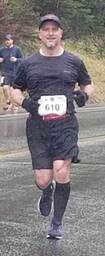
In this edition of "Meet Our Members", Kelley Carter agreed to answer our questions over email.  Kelley lives in Pittsfield and is one of the newer Central Maine Striders members.
Picture

Sugarloaf Marathon 2019

When and why did you start running?  My running can really be broken up into two distinct segments: before kids and after kids.  Before kids, I liked to run, but never really took it that seriously.  I knew that it was a "thing" that I was pretty decent at - I just never put any real effort into it.  However, I did have this crazy ambition to do the Boston Marathon - like everyone else, right?  After kids, (like 19 years after our first born), and 30lbs of added weight, I decided that I wanted to chase down that marathon goal.  So I started in December 2018, quickly discovering that my body couldn't handle the types of runs I remembered 20 years prior (go figure!).  Still, I took a careful, methodical approach, making sure to put as much effort into recovery as actual training.  From there, my goal was to stay injury-free and just have fun.

One of the things that helped trigger my return to running was the fact that I turned 50 in 2019.  Having the desire to do a marathon, I figured if I didn't do it now, I might not ever do it.  Leading up to Sugarloaf, I was pretty certain that I'd be a "one-n-done" type of marathoner.  Not fifteen minutes after completing that event, when I could barely walk from unspeakable pain I'd never felt before, my wife asked me if I'd ever do it again.  Without hesitation, I responded with a firm "hell yeah!"  I seem to have a mild obsession with it now, that I should probably seek counseling for!  I'll never be a competitive runner, but for what it does for my mental state, I hope I never have to stop.
Image description
​Did you manage to reach that Boston qualifying goal?
I have not been able to hit that BQ objective - YET!  Although my PB at the half is pretty decent for my age at 1 hr 41 min, I've had a hard time translating that to the marathon distance.  I've always seemed to show up at the starting line completely ready to go.  However, I struggle to hold back on first half of the distance.  As a consequence, I tend to hit that wall pretty hard.  During the Maine Marathon in October, my mile splits were all sub-9 minutes, and even a couple of sub-8, through mile 20.  The last 6 were barely sub-12!!  Clearly, I need to find more patience for the first half!

Was there anyone who inspired you to start running (a friend, a family members, or a professional athlete)?  I've never really thought about that, but I guess my favorite uncle first piqued my interest in running, when I saw him compete in a marathon in Austin, TX, way back in the late 70's.  But that was just one of many crazy and adventurous things he's done in his life.  I suppose I kinda follow in that same frame of mind.  There are definitely a ton of other people that have inspired me along the way.  Stories of real people doing really incredible stuff... running-related or not, surviving against insurmountable odds, or overcoming an impossible obstacle... give me strength and determination to push forward, even when I don't want to.  I also try remember to be grateful for everything I have - that there are countless humans who suffer, but are still genuinely thankful for the very little blessings they do have - those people inspire me more than any.

Of the three marathons you ran in 2019, which was your favorite and why?
Of the three marathons I ran in 2019, each offered something very special for me, and all were definite favorites for very different reasons.  Sugarloaf was special because it was my first and it was an absolute blast.  The support from the organizers, to the participants, to the wacky crowds was super cool, and made the event a ton of fun.  What wasn't fun was the cold, rainy weather!  The Maine Marathon was epic for the dedicated supporters on the sidelines - the live bands, the hilarious signs, folks cheering you on by name - awesome.  Pretty nice scenery too.  Millinocket....what can I say about Millinocket?  It is beyond words really.  In my mind, that event is all about giving back and helping that little town come alive.  It's less about running.  However!  The run is definitely part of the incredible experience, from Fireball shot stations, delicious soup, hot Gatorade, and so much more makes for a memorable experience with a huge desire to do it again.  I should mention I learned that the speedy shoes can be left at home.  This event is more like a slow, long run than a PR opportunity.  Of the three marathons, if I could only choose one to run again, for now it would have to be Sugarloaf - just to prove to myself that I can beat the 4-hour mark!!!  With assistance from gravity of course!

How did you find out about the Central Maine Striders and why did you join us?  I first stumbled across Central Maine Striders on Facebook I think, and then again on Strava.  Years ago, in Providence RI, I belonged to a corporate running group, as well as a local running club.  I remember the camaraderie, support and energy that we all benefited from, just by training and participating in events.  It was a big sense of community, and actually pushed me to train harder and more consistently that I probably would've otherwise done on my own.  I decided to join Central Maine Striders one, because the group is relatively close to where I live, and two, because I want to be more active in the running community in general.  I find running can be a pretty lonely endeavor - which isn't always bad and often times the one place where I can find peace in an otherwise chaotic world - but I miss sharing the joy of running with others.  Non-runners just don't get it, do they?  Lol.

What do you do when you're not running?
When I'm not running, I keep myself occupied with work and outdoor stuff.  Backpacking in the back-country with my family is my all-time favorite recreational activity.  Life is meant to be lived to the fullest with as many rich experiences as possible, in my opinion.  Work is just a means to an end.  Thankfully, my employer, Sebasticook Valley Federal Credit Union, gives me plenty of opportunity to do the things I enjoy the most.
Picture

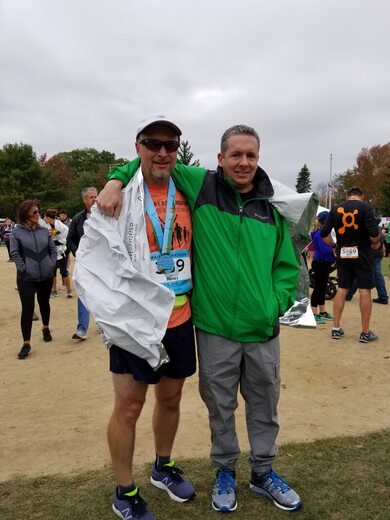
Maine Marathon 2019

Picture

Maine Marathon 2019

Thanks for joining the Striders and for letting us get to know you better, Kelley.  We're looking forward to see you at some of our events in the future (whenever that's allowed again).
Published on
by Harold Shaw

Let’s think for a minute - for the year 2020 we all probably had goal races, big plans and were going to accomplish many of them. 


Basically, my goals in 2020 were to race more than I have in a long time, well as long as the old body held up to the demands of training for an October 18th super-secret race. Unfortunately, like most of you, back in March I put all those great plans, goals, or whatever you want to call them...well to be blunt I and most other runners I know threw most everything out the window when....

The Coronavirus pandemic happened.

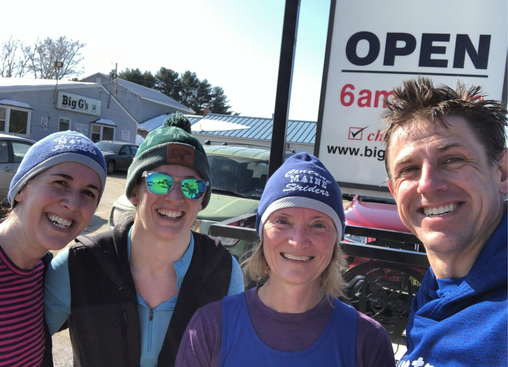
Which largely ended many of our plans for spring racing and restarting of Strider group runs (thank you Sapan, Jordan, & Julie), where members were beginning to enjoy the camaraderie of being around our friends or meeting new friends through running again. 
Picture
Unfortunately, the way things look now this pandemic has also put both the summer and possibly/probably the fall racing and schedule for any major races in jeopardy, along with Strider plans for group runs as well. This most likely means that our running will not be about preparing for racing (other than virtual races) or spending time running together anytime soon.

That sucks!!!

All those plans, goals and motivation to run - gone...so what are we supposed to do now?

Keep running of course.

Okay, enough whining about COVID 19, it is here, we are dealing with it and we have choices:

  1. Sit on the couch, watch TV, drink adult beverages, mash chips, whoopie pies or other great tasting stuff into our pie holes, add on a lot of lardage, continue to whine and complain about how unfair life is and sulk all the time. Then when you can start to train for those races your body is going to tell you in no uncertain terms I haven’t done this for awhile and probably rebel against your idea of what it should be doing.
  2. Just keep training for the races and hope that they happen.
  3. We can keep running and work on building a base, improving our weaknesses, staying healthy, and focus more on simply running to have fun.

Okay, if you are reading this newsletter and are a Strider, #1 is not the answer you are looking for. I don’t know about you, but if I stopped doing the things I still can do, I would gain 20-30 pounds over the next few months and become unhealthy again. Like most of us I have worked too hard to go back to that lifestyle. 

#2 is appealing to many of us, constantly training for races either believing that they will probably be canceled or turned into virtual races just doesn’t work for most of us. It will probably only result in injury or burn-out. 

Unfortunately, without being too negative, I just don’t see major races happening until there is a vaccine or some miracle cure comes along from the good people over at Colby - which means no major races in 2020. However, I am hopeful that there might be some smaller local races allowed in the fall.

For me, the choice was easy #3. 

Base Building - Building a good mileage base is crucial for running better - just the way it is. Putting in the miles necessary to be in shape before the training that we will be doing for races in the future is a great investment in our running - call it prep work. Especially since there is no pressure to perform or get ready for a race anytime soon, we can increase our mileage to higher levels at a healthy progression, versus the usual do too much too fast and finally get off the injured merry-go-round that many of us ride. 

Weaknesses - We all have them and yes, we hate to admit it. Whether they are strength training, yoga, pre and post-run routines, improving running form, our diet, learning more about different training methods, attempting something new versus the same old same old that we always have done, looking at changes to running shoes and of course learning more about the mental side of running. 

So much to do and so little time...well we have a little more time now to take a look at those weaknesses and make changes or turn them into strengths.

Staying Healthy - Running, in my opinion, does help to improve our health both physically, mentally and, from what I have read lately, probably helps improve the immune system as well. However, in these uncertain times, too much of a good thing can also be detrimental to our health. This is probably not the time to be doing Yasso 800s, 20+ mile training runs, 12x400 at mile race pace, or any of those myriads of workouts we runners do that leave us totally drained and may weaken our immune system at a time when we need it to be at its best.

Personally, I have taken the conservative approach and am attempting to limit my mileage to 25-35 miles a week, with most of the runs at the comfortable effort level, not a certain pace. Once or maybe twice a week, I might go ahead and do a comfortably hard run, but very little running at harder paces and then that is usually by accident. Also, I have limited my longer runs to 6-8 miles. Could I do more - sure, but at this point, I want to be healthy more than I want to increase my speed or mileage.

I know this does seem to conflict with my comments on base building, but if/when I decide to increase my base mileage I can do it intelligently and still be healthy.

Having Fun - How many of us take our running so seriously that we forget that for most of us running is not our day job and we need to look closer at why we run and if we need to make changes to make it a more positive part of our lives. Many of us plan, tinker, read about, study our training logs for trends, pour over graphs, charts and summaries of our recent efforts and we forget that our running is supposed to be something we enjoy...yeah fun, not yet another stressor in our lives. 

Think about it, when was the last time you were out on a run where you stopped, looked around and thought to yourself “How lucky I am to be out doing this thing that I love!” Smiled a big smile, laughed out loud, then sheepishly looked around quickly to see who saw you laughing and still felt like the weight of the world has been thrown off your shoulders. If it has been a while you might want to think about what running really means to you. Running should not be another chore that we dread simply to get ready for another race - a means to an end. 

Running can be so much more than that.

If you primarily run on the roads, maybe attempting some easier trails (there are several in the area), barefoot strides on grass, running at different times of the day, doing a scavenger hunt while running, stopping to take photos of odd, unusual or stunningly gorgeous scenes that you will see. There are many things that we can do while we are running to make it seem less like drudgery and more fun. 

No, it does not always mean to be plugged into your music playlist either, it might be time to listen to nature’s music.

The reality is that 

Runners run for many reasons and having the motivation of an upcoming race is great, although not being able to race is not the end of our running journey. Especially, when we are members of the Central Maine Striders because we are also a part of a larger running community that supports and helps each other with our running and often beyond running. 

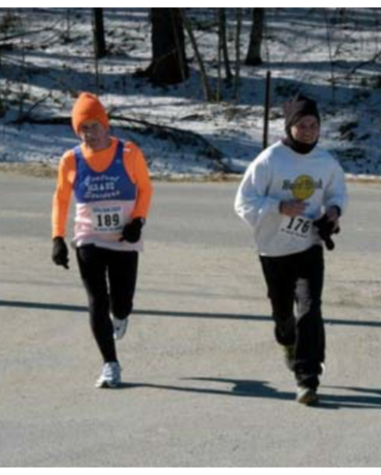
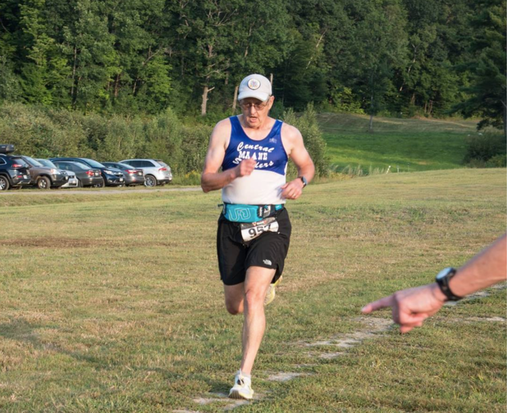
The next time you can - watch how children run. They do not run hunched over, their faces grim and focused on the ground in front of them as they gasp for air - you know like the guy in the photo below.
Picture
They run with joy, giggles and abandonment that we have forgotten in our efforts to be grown-up. Their heads are up, big grins and lots of laughter and yes, they do suddenly stop to look at the butterfly flitting around their heads or the thing crawling around on the grass. Maybe we need to lighten up and find some of that joy in our running and make running fun again.

At some point the pandemic will be under control enough so that racing and our training for those goals we have will return, but until it does we can keep running, smile more, remember to stop in the middle of a run and looking around thinking about the idea that “I get to run, versus I have to run” and yes, running can be fun. 

Who knows maybe I will get to train for that super double-secret race on October 18th, but I don’t think that I will be holding my breath too long in hopes of it actually happening.

However, I do hope that we get to start up the Strider group runs as soon as we are allowed to. Although I have a feeling that those of us who are in the more at risk group for the Coronavirus will wait until things are even more calmed down.

Stay safe and be well

Harold
Published on
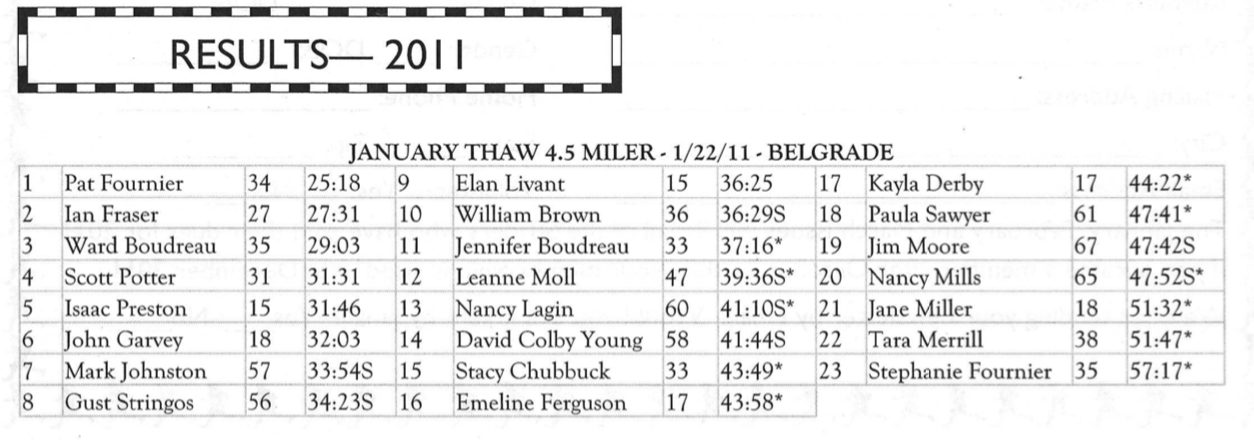
So far "Running Backwards" has taken us to 1981, 1982, and 1999. Continuing our sprint forward in time, we're heading to 2011 in this issue.  Don't worry, sooner or later, we're bound to stumble back into the 80's.
Picture
Picture
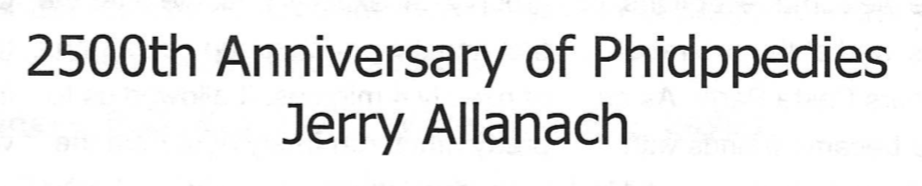
In 2011, the Interval newsletter was being cranked out on a monthly basis by Linda Benn, who had taken over the newsletter duties back in the middle of 1994 and kept at it until the end of 2014.  During 2011, the newsletter always had the masthead you see above and the clipart logo you see to the left.  Each month the front page also included a "front page" article written by a rotating cast of novelists.... oops, I meant "runners".  These articles would start on the first page and then be continued on the second page (and sometimes even onto the third page too).  As interesting as all of them are, we unfortunately don't have the space to reprint all of them here.  So, we're going to skip Craig Lewis's "The Health Benefits of Running" front page piece that was published in the January edition and move right into Jerry Allanach's article on the "2500th Anniversary of Phidppedies" (which wikipedia tells me is actually spelled "Pheidippides" or "Philippides" or "Φιλιππίδης" if you prefer Greek) and his experience running the Athens Classic Marathon.  We edited it a little bit for length.  The original filled most of the first three pages of the newsletter. 
Picture
Greek legend has it that in 490 BC, the Athenians overcame enormous odds to defeat the Persians on the plains of the village of Marathon.  As most of you know, the legend claims that the Greek soldier Phedeppides ran back to Athens and upon announcing that they had won a great victory fell dead.  I have been blessed with the opportunity to celebrate the 2500th anniversary of the Battle of Marathon by running the Athens Classic Marathon this year.

​While I learned a few things about the facts versus myths, in this article I'll share with you my experience of running a marathon that began at the site of the ancient battle field and ended on the track of the 1896 Olympic Stadium in Athens.

The journey actually began almost a year ago when Marathon Tours sent me a promotional email about a group tour that included this historic run.  Knowing that age, wear, and tear are taking its toll on my body, I figured if I only have a few marathons 
left, this one was just too unique to pass up.

When we got there, we discovered that there is actually a track that runners can warm up on.  While I don't usually warm up anymore for marathons, I couldn't resist jogging a lap in the track and field stadium in Marathon, Greece.  Numerous people dressed in 490 BC warrior attire.

I think this was my 4th marathon measured only in kilometers and I have to confess I like it.  When runners get tired in the 2nd half (not that it happens [to] you), I think the majority of us really look for the mile markers to prove to ourselves that we are still making progress toward that finish line.  I've found that even if I have to walk some, those kilometer markers come a lot quicker than mile markers, even though there are more of them.  (26.2 miles = 42.2 kilometers)  Based on my training runs, the inevitable slide with age, and the fact that it's a fairly hilly course, I had estimated that I would likely be between 4:05 
and 4:15 depending on how much the hills slowed me. 

One thing that was a first for me after 30 years of marathons, the water stops passed out bottled water, generally with the caps still on.  I would guess they were the equivalent of our 12 or 16 ounce bottles.  I drank about half each time before tossing the bottle.  Another thing that I had not seen before was runners pulling over to the side and having the backs of their legs sprayed by race volunteers with something.  The only thing I could think of was sun screen, but I found out after the race it's something that will almost instantly help loosen stiff and cramping muscles.

From about the 8k to about the 18k it was gently rolling and I was consistently under the 5:35 [per kilometer goal pace].  Then from there to about 31.5 k it was pretty much uphill.  It was warm (about 70) but not hot and the hills were long but not steep as the net gain over those 13 kilometers was about 700 feet.  My training and 
experience paid off as I was able to keep the splits between 5:25 and 5:50.  As we got closer to Athens, the cheering crowds got progressively larger and louder.

As expected, the hills had taken a toll but the good news was that the last 10k was mostly downhill.  Of course downhill hurts sore muscles more but it sure helps with pace.  Only the 42nd and final full kilometer was over 6 minutes.  Entering that 1896 Olympic Stadium will always be one of the highlights of my long running career.  It literally gave me goose bumps and I yelled as I crossed the finish line "Rejoice, we are victorious!"  I significantly exceeded my expectations with a finishing time of 3:56:42, an unexpected Boston qualifier.  I did try to check my official time but the website was "all Greek to me."  It wasn't until Thursday that I was told by another runner that there was a little British flag in the upper right corner that converted it to English.
Picture
The front page of 2011 newsletters also always had a section called "Editor's News" at the bottom of the page, where Linda Benn would share short bits, club announcements, requests for more people to write front page articles, thanks to those who had submitted front page articles, and would often include a holiday greeting in months where holidays were coming up.  Here are some excerpts from throughout the year:
Picture
Picture
Picture
Picture
Picture
Picture
Picture
Picture
Picture
Picture
Picture
Picture
Picture
Picture
Picture
Picture
Picture
Picture
Picture
Picture
Picture
Picture
Picture
Gene Roy had the front page honors for May 2011 and waxed philosophically about whether or not running is a sport.  You may notice that Page 2 starts out by saying that it was continued from Page 2.  No, the Striders did not succeed in bending the fabric of newsletter space-time.  Surprisingly, this ultramarathon-lasting copy-and-paste error persisted throughout every issue of The Interval from July 2008 until December 2011.
Picture
Picture
Picture
Picture
Picture
I don't personally know Mike Brooks, but I do know that he raced a lot, traveled a lot, and wrote three front pages of The Interval in 2011 (and is still a CMS member today).  Although all of his front page articles are interesting race reports from various corners of the US, it was his article on the back-to-back races he ran in Hawaii that was the most exciting to me.  Here are some of the highlights of that article:
The Hilo to Volcano 50k is mostly a relay race and this year had 28 solo runners.  If you are running solo, you can start when you want and tell the officials at the finish line your time.
Outside a bar, there were a bunch of drunks getting ready to fight, one had a knife, this quickened my pace for a short distance. 
I thought the race started on Coconut Island, but it actually starts in the parking lot for the island on the other side of the bridge to the island.  My friends hollered and screamed out my name, but I never heard them.  They waited a few minutes, then started without me.  I waited for them about ten minutes, then started.  Outside a bar, there were a bunch of drunks getting ready to fight, one had a knife, this quickened my pace for a short distance.  Catching my friends a few miles later made me feel a little better knowing I would have some company in the race.  There are no aid stations on the course, so Denise drove the course supplying us with what 
we needed.

It stayed dark until 6:30, the clouds kept the temperature in the 60's and at times there was a light drizzle.  Once it got light I noticed Walt [Mike's brother], a very experienced ultrarunner, had new shoes.  They were on sale for $40, big mistake.  As we continued towards the Volcano, Walt's feet started to blister badly.  The last 4 miles is when the sun came out, it was in the 80's and Walt was doing a painful run/walk routine.

After crossing the finish line, we told the race director our times and thanked him for putting on a race for 30 bucks which included a long sleeve tech shirt, finisher's medal, and lei.

It was then a shower and off to the airport for our flight back to Honolulu for a connecting flight to the island of Maui.

 
[The next morning,] I walked from the hotel to where the bus would pick us up and drop us off at the early 4:30am start.  We got there late and the race had already started.  

Once sunrise arrived, we were treated to
Walt wore sandals  in this race because his feet were so blistered.  I bet he does not wear new shoes in a 50k again.
 ocean views for 20 miles and saw whales in the distance several times.

Walt wore sandals  in this race because his feet were so blistered.  I bet he does not wear new shoes in a 50k again.

It was now time to relax.  The next three days were spent lounging around the pool, snorkeling, and whale watching.

​In conclusion, let me say that I think most runners would like the Maui marathon.  It is a very scenic course, lots of aid stations and just a few steep hills.  On the downside, it will probably be hot and all the races are expensive [there's also a half marathon and 5k].  The Hilo to Volcano 50k is not scenic, has 4000' of elevation gain, no aid stations or spectators.  On the upside, it's only 30 bucks, you can start whenever you want and it is one of the easier ultras in the Hawaiian Islands.
In April 2011, several Striders ran in the Unity Spring 5k and in the Fly Like an Eagle 5k (which was a race held at Erskine Academy in South China).
Picture
Picture
Picture
Picture
Picture
Picture
Picture
Picture
Picture
Picture
Picture
Picture
Picture
Ron Paquette took over the front page article in June of 2011 and offered his thoughts on the cost of running.
Picture
Picture
Picture
Picture
Picture
Picture
Picture
Picture
Picture
Picture
Picture
Picture
Picture
Picture
Picture
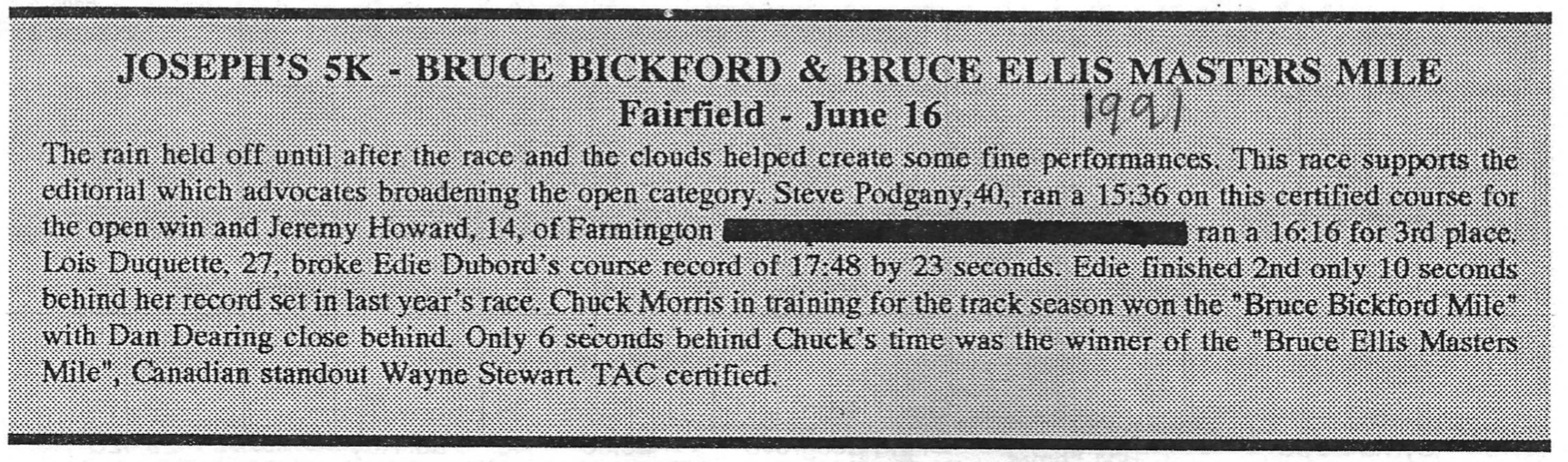
The July edition of the newsletter featured an early version of "Running Backwards", or at least a look back at the results of the Joseph's 5k from 20 years earlier.  We're not sure what top secret information got redacted here.
Picture
Picture
Picture
Picture
Picture
Picture
Picture
Picture
Picture
Picture
Picture
Picture
Picture
Gene Roy used the front page of the October 2011 Interval to tell a story about telling stories.
Picture
My Dad used to tell stories.  Usually this happened while we were riding in the car or sitting around a campfire in the dark of night.  There weren't many choices for my brothers and I when it came to avoiding a story we'd heard before.  We could step outside the car or wander around in the dark.  I'm certain that your Dad told stories too.  Most of the time they weren't bad, they were just re-runs.  We'd heard them all before.  He would relate incidences that had taken place some years before; many of these were reports of weather, personal achievements, or his experiences.  My brothers and I would look at each other and roll our eyes.  To his credit, the stories he told never changed nor did they get exaggerated with age.  There was of course no way to corroborate the facts.

So now I find myself telling stories to my kids.  I realize I'm doing it as soon as I start and I can't stop myself!  My kids listen politely and they don't stop me to say ​they've heard it before.  When I recognize it's a told tale, I still have a hard time stopping.  

If you're wondering what this has to do with running, well let me tell you a tale.... don't roll your eyeballs!
This is a story about racing, then and now.  "Then" happened in the early 80's, I will refer to this time as the "Golden Age of Road Racing".  The "Now" is the year 2010 for which I have data for all the races that are still around.

During my competitive years, I kept all my racing results and the complete results for that race.  I also kept data on weather, and type of workout for each day.  I kept track of weekly, monthly, and yearly mileage.  I did this for more than ten years.  I have plenty of hard data to back my claims.

My point here is that racing in the 80's was more competitive than it is now.  The fields in many of the races today are larger than they were then.  Though many of the races from that era are gone now, many new races have taken their places.

[Gene then goes on to provide several examples of his race times from "Then" and how that same race time would earn him a better finish position in that race "Now".]

So what's different?  I believe it's the approach to training.  Does  anyone take their pulse
every morning?   Run 70 mile weeks?  run two a days?  Do two speed workouts a week?  Average 2700 miles a year or own a pair of skin calipers?  Can you expect great results on casual training?  Or, without reading the latest research results on training?  I'm saying the level of commitment to training has lowered a lot.  The selection of races reflects this casual approach to training, most 10k's are gone and in their places are 5k's.  Many of the longer runs are gone too and you don't see 6-10 runners running a 20 on a Saturday morning.

Many of the best races are gone now and it wouldn't be fair to compare times in different races.  For now at least the 5k reigns as a popular race distance, but I must tell you that I don't have a personal best for a 5k.  I never ran one in those days, they were very rare.  I think the only place they were run was on a track.

Will we ever return to the days of hard nosed training and racing?  Probably, everything goes in cycles.  Maybe 10k's will make a comeback.  Runners will look at their times and wonder what they can do to become faster.  At that point, the "Then" will be now and the "Now" will be then.
Gene, I think some runners "Now Now" (2020) would disagree with some of your claims about "Now" back then or even "Then" back then, but you're still more than welcome to tell us some stories, regardless of whether they're from "Then" or "Now" or "Now Now".  We won't even mind if you've told them before.  We're happy to have you as a Central Maine Strider, for both the contributions you made back "Then" and the contributions you continue to make to the club "Now Now."
Picture
Picture
In 2011, The Interval even had a random Sudoku puzzle published in it.  We're sorry that we no longer have one without the solution already written into it.
Picture
Picture
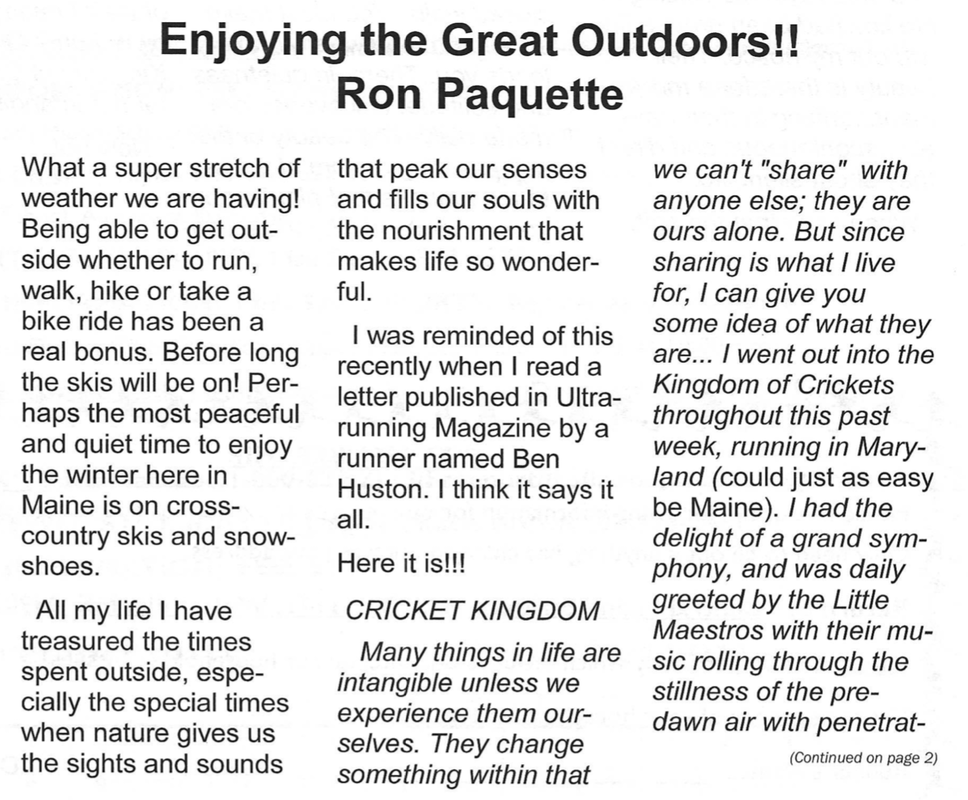
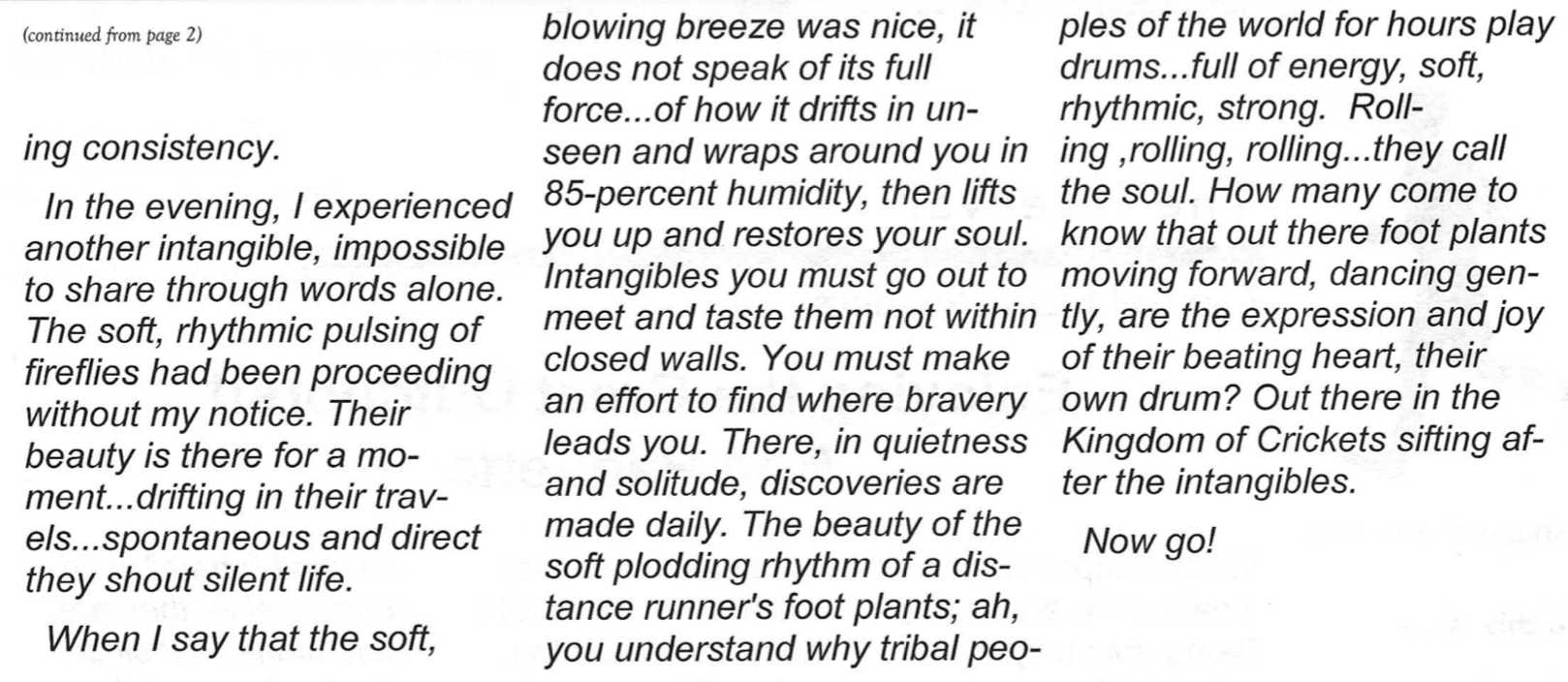
The November 2011 issue of The Interval featured a front page article by Ron Paquette, which featured a nice piece about crickets that he found in Ultrarunning Magazine.
Picture
Picture
David Benn used his time to write the front page Interval article in December 2011 to cover the Champions Thanksgiving Day 10k.
Picture
Picture
Picture
Picture
Picture
Picture
Picture
Picture
Picture
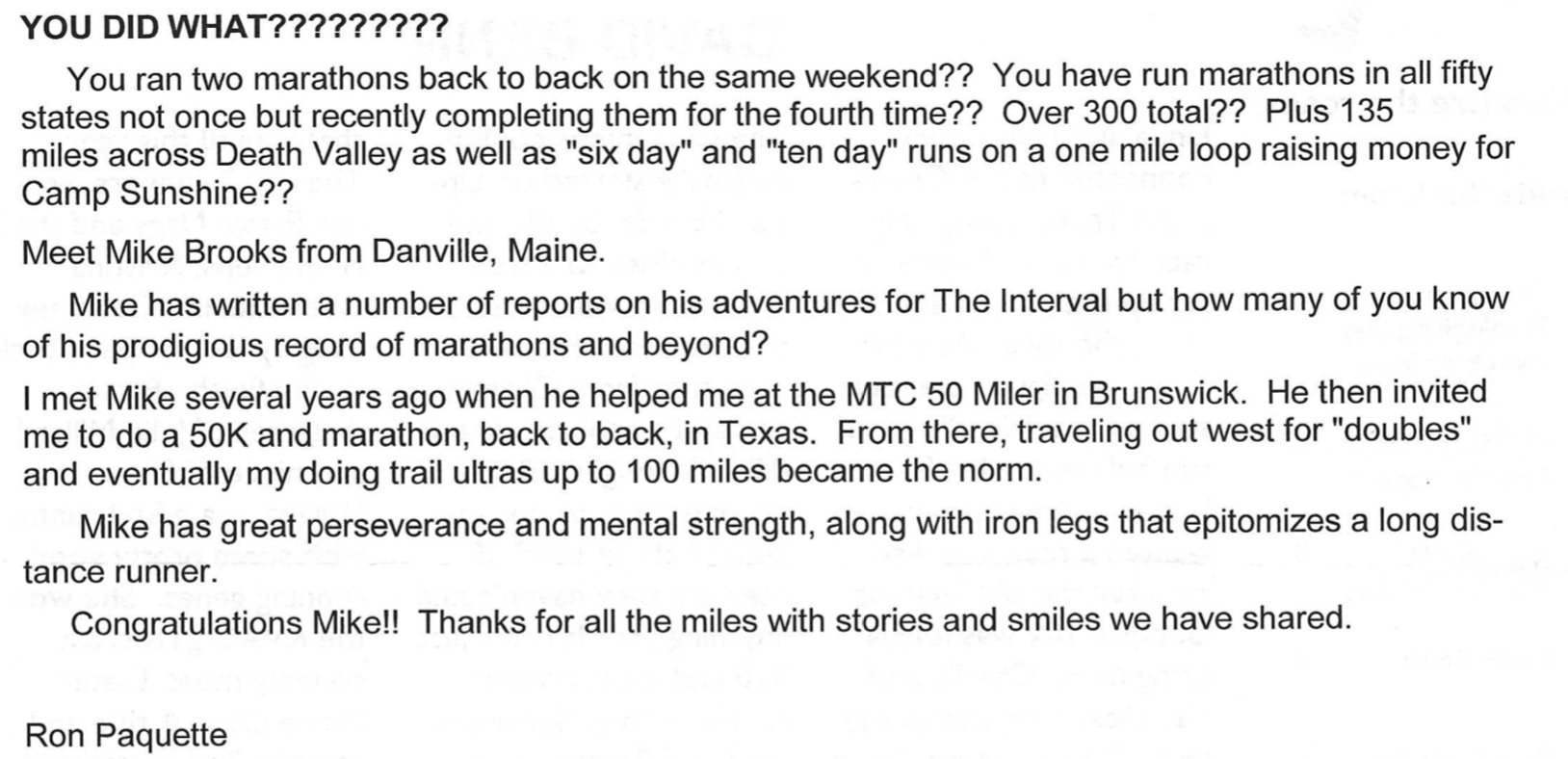
Mike Brooks had been mentioned several times in this edition of Running Backwards.  For those of you who don't know who he is, Ron Paquette has this great writeup about Mike in the December 2011 newsletter.
Picture
And just like that, we've made it to the end of 2011.  Thanks for jogging back with us.  We hope you enjoyed it!
Published on
Jordan Castillo moved to central Maine a couple years ago.  The first time he attended a Central Maine Striders meeting was last December.  By the end of that meeting, he had been voted in as the new club Vice President.  In his short tenure as the VP, he's organized several group runs (and brunches), started the club's Instagram account, and generally been one of the more energetic and enthusiastic club members.  One weekend at brunch this winter, he shared the story of how he started running.  It was such a great story that I asked him if he could write it up for the club webpage and newsletter.  So, just in case you weren't at that brunch, here's Jordan's running story:

"Hey, how about we run a marathon?"

One day after school during my 10th grade year, my dad asked me a question that became the spark to a life-changing journey.
 
“Hey, Jordan, how about we sign up for a marathon?”
 
I turned to him and gawked at this absurd-sounding question. “Dad, what? Are you for real?”
With confidence and excitement, he responded, “Yeah! Your younger brother is going to join, too! C’mon! It’ll be fun!”
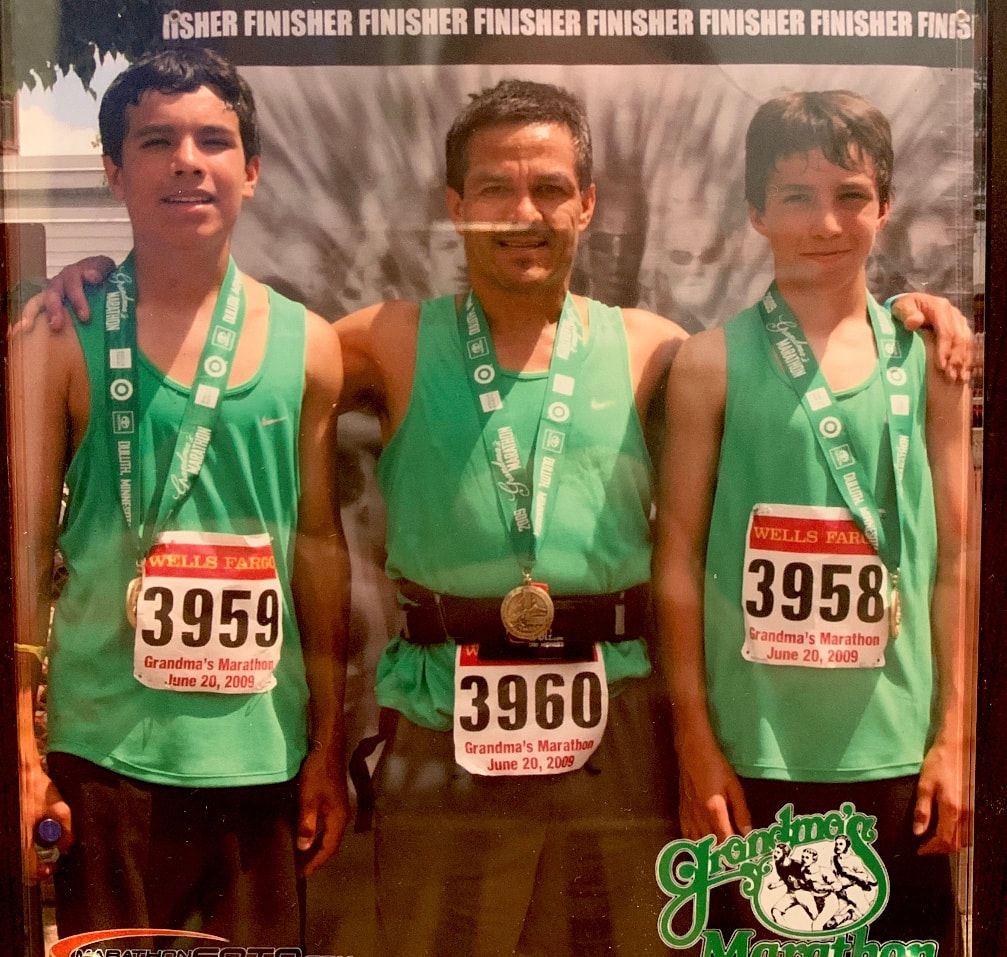
After feeling a bit uncertain, I eventually agreed to sign up with my dad and brother for Grandma’s Marathon, set to take place June 20, 2009 in Duluth, MN. I felt like I had no idea what I was signing up for. But if my dad believed I could run a marathon, then so did I.​

​Training began in January, which means I quickly learned how to brave running with near-zero temperatures and snow-covered sidewalks. Our first run was three miles at a slow, jogging pace. It was a slog. At the end of the run, I probably screamed something like, “Dad, how the heck are we going to get up to 26.2 miles? Three miles is enough, this is crazy!”

Picture

I was so excited to finish my first ever marathon... you can tell how tired I was (I'm on the left)!

Slowly, but surely, my brother and I began to see the results of our training. Three miles started to feel like a warm-up distance. I began to feel like I could slow my breath enough to even carry a conversation while running. The first time I finished a 13.1-mile run, I felt like a straight-up champion. Many times, my brother and I would join my dad’s running club for long runs on the weekends. The runners carried such an encouraging, infectious energy. They loved seeing young people like my brother and I training for a such a big race, and it was always motivating to hear their stories about running accomplishments and the goals they were setting for themselves.

​As the weeks passed, I came to believe that finishing a marathon was actually possible—I just had to stick with the training plan and know that my body was capable of carrying me further than I could ever imagine.

​Fast-forward to race day. I had barely slept because I was so nervous and excited. With my green singlet and black running shorts, I joined the other runners in the starting area. It was a clear, sunny day and 6,000 of us were about to embark on this 26.2-mile journey along the beautiful north shore of Lake Superior.
I also need to take a moment to explain what it felt like to be at that starting line. If you’ve ever participated in a race, you know that the race environment is unreal—full of positivity, motivation, excitement, and thrill. The energy is so electric, it’s almost tangible. Another part of my experience is that some of the runners would give looks of delightful surprise to see my brother and I with our race bibs labeled with the word “Marathon.” I knew I wasn’t about to break any world records or anything, but it felt pretty great knowing that I was one of the youngest people in the race. Standing with the thousands of others about to run Grandma’s Marathon, I truly felt like there was no place I’d rather be, nothing I’d rather be doing than finishing my first marathon.

​“3, 2, 1!” 
Bang. And the race began.
Picture

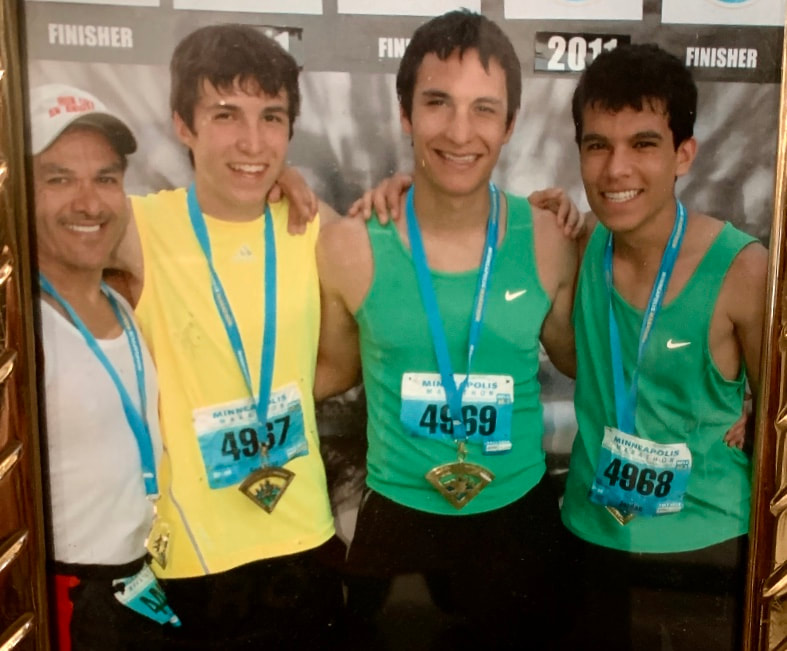
The 2011 Minneapolis Marathon was the first race I did with both my brothers and my dad... we all finished together!

One of my strongest memories of the race is the feeling of camaraderie between my dad, my brother, and me. They always kept me focused on the goal, especially near the end when I felt more fatigued than ever and I began to seriously doubt whether I could finish. I also remember all the fans on the side of the road who encouraged us and handed out free water, Gatorade, salty snacks. Some of the fans even had water hoses to cool us off, and some were literally grilling on the side of the road and giving out hot dogs and hamburgers. There were so many moments during the race when I just felt rushes of gratitude and excitement from seeing all the fans. Crowd support makes such a huge difference!
Image description
Around mile 23, I started to hit “the wall.” Each step felt like it required ten times the normal amount of effort, and I felt all my muscles ache with each strike of the ground. I actually remember feeling angry and wondering why I was running the race in the first place. My brother was so good at reminding me that this race was possible and that we were going to make it to the end. I was in so much pain, so my brother’s encouragement made a huge difference.

Without a doubt, the final .2 miles of the race was the most agonizing, challenging part. I remember passing the 26th mile marker and thinking, “Wow! I’m done! We are at the finish line!” But the reality is that .2 miles is still .2 miles. It also didn’t help that there were still a few turns after mile 26, so I couldn’t even see the finish line until a minute or so after passing the final mile marker. When I eventually did see that finish line, though, I ran with everything I had.

“From Lakeville, Minnesota, we have Jordan and Spencer Castillo, about to finish their first Grandma’s Marathon!” The announcer was cheering us on, along with the hundreds of fans lining each side of the road. Those last few seconds of the race seemed to last an eternity, and I couldn’t believe that I was actually about to be done running those 26.2 miles. With a time of just under five hours, my brother and I crossed the finish line. My dad and brother were right there, and we grabbed each other with a sweaty, beautiful embrace. I felt a sudden rush of accomplishment, relief, pride, and overwhelming joy like I’d never felt before. At the age of 16, I had just finished my first marathon.
Picture

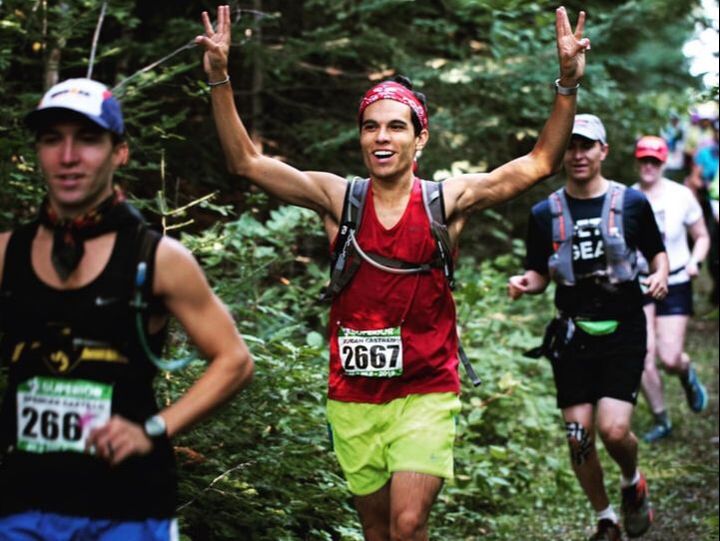
Last year's Moose Mountain Trail Marathon... you can tell it's only mile 2, I've still got so much energy! =D

Picture

Moose Mountain Trail Marathon victory photo with the bro's... feeling so fortunate to finish this race with them!

During the drive home, my Dad turned to my brother and me and blurted, “So, who’s ready for the next marathon?”

​“Haha, are you kidding me? Too soon, Dad,” I answered. “Maybe in a month, you can ask me then.” And a few months later, my dad did, in fact, ask me about running Grandma’s Marathon again.

 
“Sure, why not,” I responded with a soft smile.
 
So, the next year, I ran my second Grandma’s Marathon. The year after that, I ran another marathon with my dad, and the year after that, too. Because of that initial nudge from my dad, I have been running long-distance consistently for 11 years now. I am proud to say that last month I completed my tenth marathon in Napa, California (with a PR of 3:29!), and in less than three months I will go back to where it all began to run Grandma’s Marathon again, this time with the intention of qualifying for the Boston Marathon.
Running has become my stress-reliever, my motivator, my opportunity to center myself and reflect on things like gratitude, well-being, and vision for my life. Running reminds me that I am always capable of more than I might think in a moment, and that our realities are largely defined (and sometimes limited) by our minds. Running has become my way to communicate a mantra to the universe: “I can.”

 
Thanks for reading this story. Each member of the Central Maine Striders community has their own unique “why” behind running, and I am grateful for the opportunity to share about mine.

 
To close, I’d like to leave you with something to reflect on: What is your “why” behind running? And what might your running experience be teaching you?
Picture

I convinced my good friend, Luis, to run Napa Valley Marathon with me last month. Running with friends gives me LIFE!

Thanks for sharing your running story with us, Jordan!  We love the energy and enthusiasm that you've brought to the club.

If any of you would like to be featured in a "Meet Our Members" article, contact us at run@centralmainestriders.com.  We'd be more than happy to publish your running story and/or interview you.